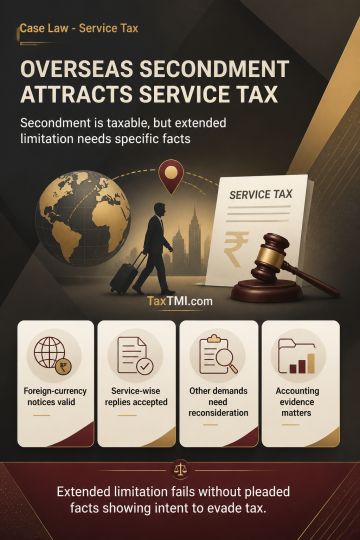
Extended limitation fails without specific suppression allegations, while overseas employee secondment remains taxable as manpower supply within norma...
Time-share accommodation classification excludes Club or Association Service where purchasers receive contractual occupancy rights without genuine mem...
CENVAT credit for trading requires reversal, while taxable-service rental credit remains proportionately available and limitation issues await resolut...
Vicarious liability for dishonoured company cheques may extend to non-signatory directors where complaints contain foundational responsibility avermen...
Validity of input tax credit (ITC) u/s 16 of the UP GST Act hinges on compliance with specified conditions to avoid double taxation. The burden lies on the dealer to prove fulfillment of conditions for claiming ITC. Merely producing tax invoices, e-way bills, and banking channel payments is insufficient. Proof of actual physical movement of goods, genuineness of transportation, payment of freight charges, acknowledgment of delivery, toll receipts, and filing of GSTR 2A is necessary. The Supreme Court has held that the primary burden is on the dealer to furnish details like selling dealer, vehicle number, freight payment, delivery acknowledgment, tax invoices, and payment particulars to establish actual goods movement. Submitting only invoices, e-way bills, or payment details is inadequate. Consequently, the High Court dismissed the writ petition, upholding the orders denying ITC for non-compliance with statutory conditions.
Validity of input tax credit (ITC) u/s 16 of the UP GST Act hinges on compliance with specified conditions to avoid double taxation. The burden lies on the dealer to prove fulfillment of conditions for claiming ITC. Merely producing tax invoices, e-way bills, and banking channel payments is insufficient. Proof of actual physical movement of goods, genuineness of transportation, payment of freight charges, acknowledgment of delivery, toll receipts, and filing of GSTR 2A is necessary. The Supreme Court has held that the primary burden is on the dealer to furnish details like selling dealer, vehicle number, freight payment, delivery acknowledgment, tax invoices, and payment particulars to establish actual goods movement. Submitting only invoices, e-way bills, or payment details is inadequate. Consequently, the High Court dismissed the writ petition, upholding the orders denying ITC for non-compliance with statutory conditions.
Note: It is a system-generated summary and is for quick reference only.
 TaxTMI
 of 4801








 Join Channel


 TaxTMI