Authentication of paper assessment orders upheld, while qualifying repairs, consumables and vendor advance write-offs remain deductible business claim...
Transaction value cannot be rejected solely on non-statutory valuation guidelines without corroborative evidence supporting reassessment of final cust...
Cross-examination rights and corroborated evidence limit customs penalties for misdeclaration in genuine import transactions involving documented clea...
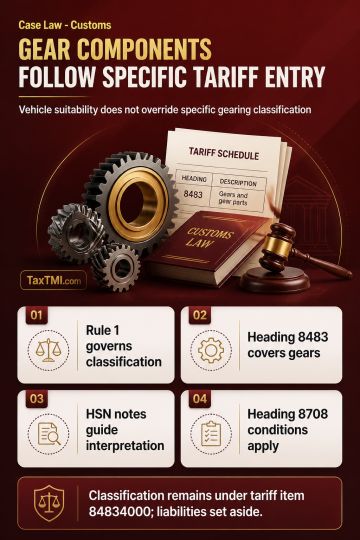
Tariff classification of vehicle gear components follows the specific gearing entry, displacing motor-vehicle parts classification and related liabili...
The impugned orders u/s 16(2)(c) of the CGST/DGST Act, 2017 demanding excess Input Tax Credit (ITC) due to non-reconciliation of information are set aside as they lack reasoning and violate principles of natural justice by not dealing with explanations submitted. The Court noticed a pattern of unreasoned orders being passed near the limitation period's expiry, merely reproducing show cause notice details without addressing taxpayer explanations. The respondent conceded the retrospective GST registration cancellation of M/s Feron Life Sciences was restored, a relevant factor for considering the petitioner's demand. Consequently, the matter is remanded to the Proper Officer for fresh consideration, examining the petitioner's reply and affording a personal hearing opportunity. The petition is disposed of by way of remand.
The impugned orders u/s 16(2)(c) of the CGST/DGST Act, 2017 demanding excess Input Tax Credit (ITC) due to non-reconciliation of information are set aside as they lack reasoning and violate principles of natural justice by not dealing with explanations submitted. The Court noticed a pattern of unreasoned orders being passed near the limitation period's expiry, merely reproducing show cause notice details without addressing taxpayer explanations. The respondent conceded the retrospective GST registration cancellation of M/s Feron Life Sciences was restored, a relevant factor for considering the petitioner's demand. Consequently, the matter is remanded to the Proper Officer for fresh consideration, examining the petitioner's reply and affording a personal hearing opportunity. The petition is disposed of by way of remand.
Note: It is a system-generated summary and is for quick reference only.
 TaxTMI
 of 4805






















 Join Channel


 TaxTMI
