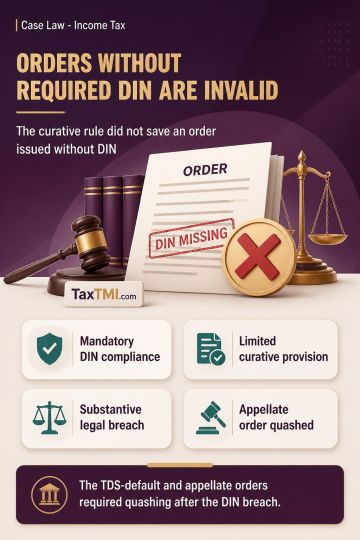
Document Identification Number compliance renders TDS-default orders invalid where mandatory DIN requirements are breached and curative provision does...
Insolvency and BankruptcyAugust 17, 2024Case LawsHC
Violation of res judicata principles u/s 11 of the Code of Civil Procedure, 1908, suppression of relevant facts from the Committee of Creditors (CoC), discrepancy in examining financial capability and eligibility of a Joint Resolution Applicant who is a former director of the Corporate Debtor and also a director in another company undergoing CIRP proceedings, disposal of the Corporate Debtor's assets without CoC approval, executing lease agreements with Prospective Resolution Applicants without CoC approval, and the review of an order by the Disciplinary Committee. The key issues are the eligibility of the Joint Resolution Applicant, non-compliance with Section 30(2) of the Insolvency and Bankruptcy Code regarding the Resolution Professional's obligations, and the Disciplinary Committee's jurisdiction to sit in appeal against its own order. The court held that the principles of res judicata do not apply, the Resolution Professional failed to exercise due diligence, and the Disciplinary Committee's determination regarding the Resolution Professional's contraventions was appropriate, leading to the dismissal of the petition.
Violation of res judicata principles u/s 11 of the Code of Civil Procedure, 1908, suppression of relevant facts from the Committee of Creditors (CoC), discrepancy in examining financial capability and eligibility of a Joint Resolution Applicant who is a former director of the Corporate Debtor and also a director in another company undergoing CIRP proceedings, disposal of the Corporate Debtor's assets without CoC approval, executing lease agreements with Prospective Resolution Applicants without CoC approval, and the review of an order by the Disciplinary Committee. The key issues are the eligibility of the Joint Resolution Applicant, non-compliance with Section 30(2) of the Insolvency and Bankruptcy Code regarding the Resolution Professional's obligations, and the Disciplinary Committee's jurisdiction to sit in appeal against its own order. The court held that the principles of res judicata do not apply, the Resolution Professional failed to exercise due diligence, and the Disciplinary Committee's determination regarding the Resolution Professional's contraventions was appropriate, leading to the dismissal of the petition.
Note: It is a system-generated summary and is for quick reference only.
 TaxTMI
  TaxTMI
 of 4918