Online bond platforms may offer overseas-regulated products and tax-specific bonds subject to disclosures, compliance safeguards and revised complianc...
Corporate guarantee valuation permits actual ascertainable commission while barring retroactive application and extended-period penalties for bona fid...
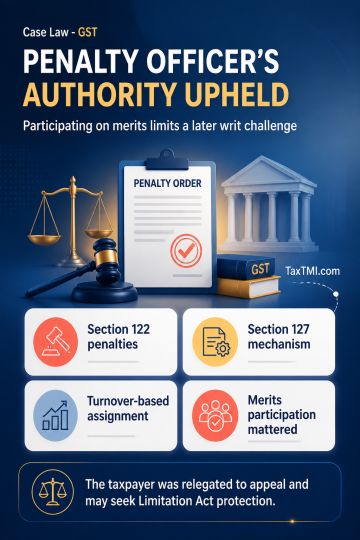
Proper-officer jurisdiction under UPGST penalty provisions upheld; participation on merits prevents bypassing the statutory appellate remedy through w...
Transitioned CENVAT credit may validly satisfy mandatory pre-deposit requirements for legacy service tax appeals through Electronic Credit Ledger debi...
Building-plan sanction charges require statutory authority; unauthorised fees and GST were quashed, while labour cess must follow prescribed collectio...
Pure-agent exclusion fails where hotel booking facilitators receive third-party services themselves, making entire customer consideration taxable as r...
Penalty u/s 271(1)(c) was imposed for excess deduction claimed u/s 10B. The assessee furnished all relevant facts for computing total income, and provided detailed explanations regarding the claim u/s 10B, including the number of manufacturing divisions, bifurcation of expenditure, and availability of carried forward losses. The explanation was not found false, and the onus to prove falsity lies on the revenue. The claim was an allowable deduction, though the quantum was reworked by the Assessing Officer using different arithmetic. All details and justifications were provided in the return itself. The amount of tax sought to be evaded under explanation 1 to section 271(1)(c) was indeterminable for imposing penalty. The assessee's decision to not appeal the reduction of claim does not imply lack of bona fides. The CIT(A) rightly deleted the penalty, and no interference is warranted.
Penalty u/s 271(1)(c) was imposed for excess deduction claimed u/s 10B. The assessee furnished all relevant facts for computing total income, and provided detailed explanations regarding the claim u/s 10B, including the number of manufacturing divisions, bifurcation of expenditure, and availability of carried forward losses. The explanation was not found false, and the onus to prove falsity lies on the revenue. The claim was an allowable deduction, though the quantum was reworked by the Assessing Officer using different arithmetic. All details and justifications were provided in the return itself. The amount of tax sought to be evaded under explanation 1 to section 271(1)(c) was indeterminable for imposing penalty. The assessee's decision to not appeal the reduction of claim does not imply lack of bona fides. The CIT(A) rightly deleted the penalty, and no interference is warranted.
Note: It is a system-generated summary and is for quick reference only.
 TaxTMI
 of 4798



















 Join Channel


 TaxTMI