Patent-settlement expenditure treated as commercially expedient revenue outlay, with foreign-law restrictions inapplicable before the prospective amen...
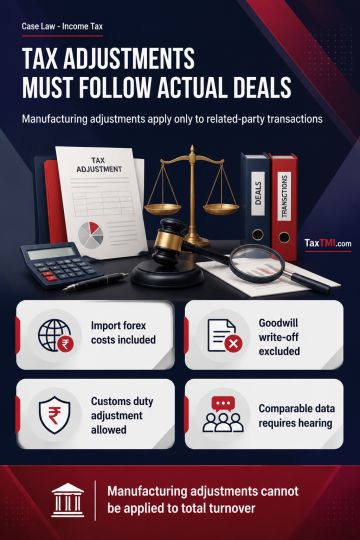
International transaction benchmarking restricts transfer pricing adjustments to associated-enterprise dealings, while functional comparability govern...
Joint development agreements defer taxable transfer where possession lacks part performance, while completed flats determine consideration and exempti...
Passenger baggage re-export requires true declaration and cannot be granted indirectly through discretionary redemption of undeclared prohibited goods...
Page of 4803
Press 'Enter' after typing page number.
501 to 520 of 96046 Results
❮
❯
❯❯
0 / 200
Expand Note
Add to Folder
No Folders have been created
+
Are you sure you want to delete "My most important" ?
Penalty u/s 271(1)(c) was imposed for excess deduction claimed u/s 10B. The assessee furnished all relevant facts for computing total income, and provided detailed explanations regarding the claim u/s 10B, including the number of manufacturing divisions, bifurcation of expenditure, and availability of carried forward losses. The explanation was not found false, and the onus to prove falsity lies on the revenue. The claim was an allowable deduction, though the quantum was reworked by the Assessing Officer using different arithmetic. All details and justifications were provided in the return itself. The amount of tax sought to be evaded under explanation 1 to section 271(1)(c) was indeterminable for imposing penalty. The assessee's decision to not appeal the reduction of claim does not imply lack of bona fides. The CIT(A) rightly deleted the penalty, and no interference is warranted.
Penalty u/s 271(1)(c) was imposed for excess deduction claimed u/s 10B. The assessee furnished all relevant facts for computing total income, and provided detailed explanations regarding the claim u/s 10B, including the number of manufacturing divisions, bifurcation of expenditure, and availability of carried forward losses. The explanation was not found false, and the onus to prove falsity lies on the revenue. The claim was an allowable deduction, though the quantum was reworked by the Assessing Officer using different arithmetic. All details and justifications were provided in the return itself. The amount of tax sought to be evaded under explanation 1 to section 271(1)(c) was indeterminable for imposing penalty. The assessee's decision to not appeal the reduction of claim does not imply lack of bona fides. The CIT(A) rightly deleted the penalty, and no interference is warranted.
Note: It is a system-generated summary and is for quick reference only.
 TaxTMI
 of 4803



















 Join Channel


 TaxTMI