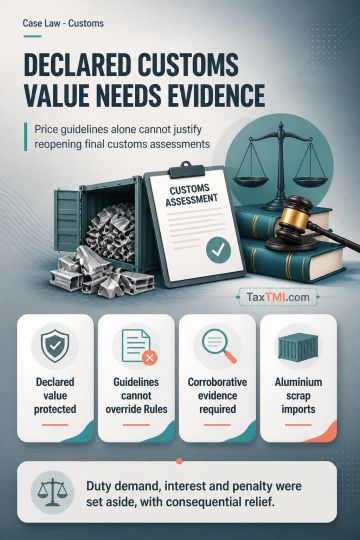
Transaction value cannot be rejected solely on non-statutory valuation guidelines without corroborative evidence supporting reassessment of final cust...
Cross-examination rights and corroborated evidence limit customs penalties for misdeclaration in genuine import transactions involving documented clea...
Tariff classification of vehicle gear components follows the specific gearing entry, displacing motor-vehicle parts classification and related liabili...
Necessary-party requirements limit impleadment of independent entities, while deferred consideration does not create an appealable adverse determinati...
Food supplement classification requires common parlance and authoritative tests, preventing treatment as proprietary Ayurvedic medicines without suppo...
The assessee, an NRI and resident of USA, transferred a capital asset and derived capital gain. The asset comprised rights and interests acquired through an assignment deed executed in USA. The Assessing Officer treated the gain as short-term, restricting the holding period to less than 24 months based on an employment agreement. However, the Tribunal held that since no shares were delivered to the assessee, the capital asset did not qualify as shares/securities of an Indian company u/s 2(42A). As the asset was held for less than 36 months, it was rightly treated as short-term. Regarding taxability in India u/s 9(1)(i), the Tribunal held that the situs of the capital asset was in USA, where the assignment deed was executed, and the termination agreement specified California courts' jurisdiction. Therefore, the capital gain derived from transfer of the asset situated outside India was not taxable in India. However, as the assessee had voluntarily filed a return offering the gain as long-term, the Tribunal directed the AO to accept the capital gain offered in the return.
The assessee, an NRI and resident of USA, transferred a capital asset and derived capital gain. The asset comprised rights and interests acquired through an assignment deed executed in USA. The Assessing Officer treated the gain as short-term, restricting the holding period to less than 24 months based on an employment agreement. However, the Tribunal held that since no shares were delivered to the assessee, the capital asset did not qualify as shares/securities of an Indian company u/s 2(42A). As the asset was held for less than 36 months, it was rightly treated as short-term. Regarding taxability in India u/s 9(1)(i), the Tribunal held that the situs of the capital asset was in USA, where the assignment deed was executed, and the termination agreement specified California courts' jurisdiction. Therefore, the capital gain derived from transfer of the asset situated outside India was not taxable in India. However, as the assessee had voluntarily filed a return offering the gain as long-term, the Tribunal directed the AO to accept the capital gain offered in the return.
Note: It is a system-generated summary and is for quick reference only.
 TaxTMI
 of 4805





















 Join Channel


 TaxTMI
