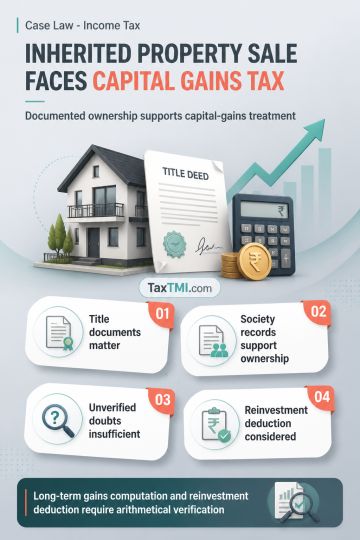
Inherited property sale proceeds require capital-gains treatment where ownership is supported by evidence, not suspicion or unverified signature doubt...
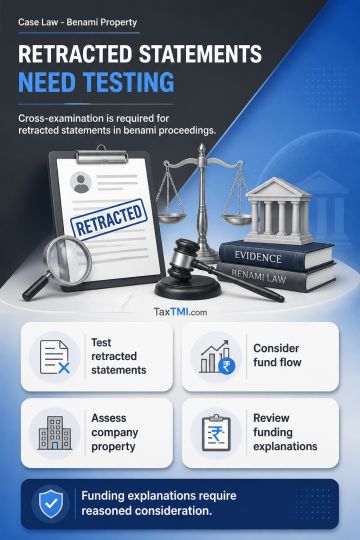
Cross-examination of retracted statements is essential where foundational evidence supports a benami allegation and documented funding explanations re...
Capital-goods exemption covers plant-modernisation accessories, while the import restriction applies only to earlier capital-goods components and spar...
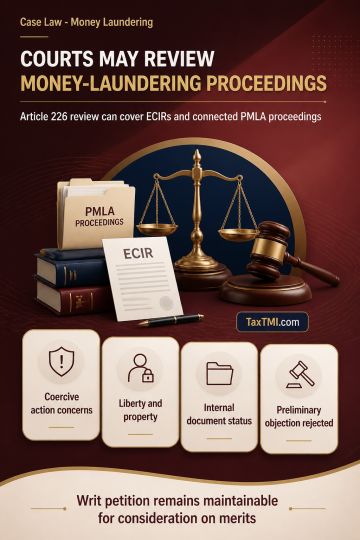
Constitutional judicial review permits challenges to ECIRs and connected money-laundering proceedings where coercive action affects fundamental intere...
In a case concerning unexplained credit u/s 68, the assessee proved the identity and genuineness of share applicants, although their creditworthiness was questioned. The court held that if the assessing officer doubts creditworthiness, verification should be done in the shareholders' hands, not the assessee company's. If shareholders are identified, non-fictitious, and payments made through banking channels, no addition u/s 69 is permissible. The assessee provided ITRs, bank statements, and PAN details, proving shareholders' identity, genuineness, and creditworthiness. Regarding ad hoc expense disallowance for lack of bills/vouchers, the court observed the assessing officer failed to pinpoint specific expenses and deleted the disallowance. On share application money treated as unexplained u/s 68, the court held that for small investors investing limited amounts, creditworthiness cannot be doubted solely for non-filing of ITRs/bank statements when identity and genuineness are proved through application forms and receipts. Once shareholder identity is proved, the assessee's onus to prove the source is discharged.
In a case concerning unexplained credit u/s 68, the assessee proved the identity and genuineness of share applicants, although their creditworthiness was questioned. The court held that if the assessing officer doubts creditworthiness, verification should be done in the shareholders' hands, not the assessee company's. If shareholders are identified, non-fictitious, and payments made through banking channels, no addition u/s 69 is permissible. The assessee provided ITRs, bank statements, and PAN details, proving shareholders' identity, genuineness, and creditworthiness. Regarding ad hoc expense disallowance for lack of bills/vouchers, the court observed the assessing officer failed to pinpoint specific expenses and deleted the disallowance. On share application money treated as unexplained u/s 68, the court held that for small investors investing limited amounts, creditworthiness cannot be doubted solely for non-filing of ITRs/bank statements when identity and genuineness are proved through application forms and receipts. Once shareholder identity is proved, the assessee's onus to prove the source is discharged.
Note: It is a system-generated summary and is for quick reference only.
 TaxTMI
 of 4786







 Join Channel


 TaxTMI