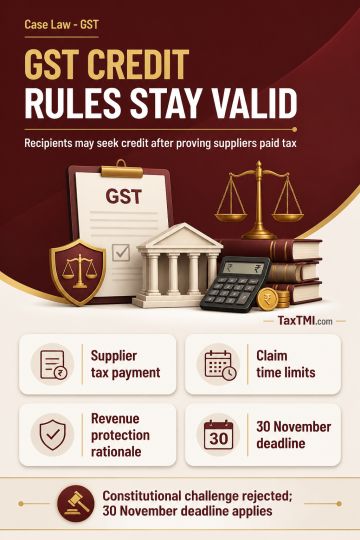
Input tax credit conditions remain constitutionally valid, with eligible recipient claims considered under GST circulars and retrospective filing dead...
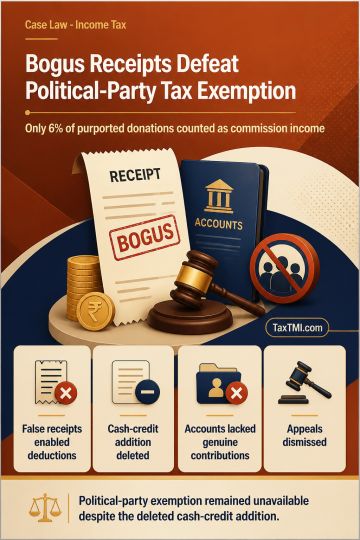
Bogus donation receipts justified commission income assessment and defeated political-party tax exemption for inaccurate accounts and reporting failur...
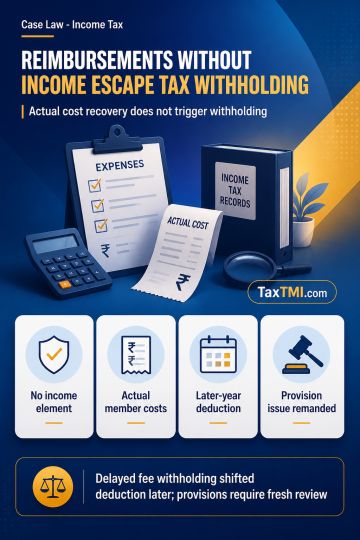
Pure reimbursement without income element escapes tax withholding, while delayed withholding and unsupported provisions face deferred or renewed scrut...
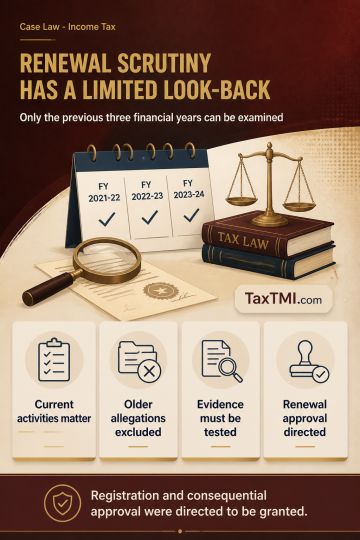
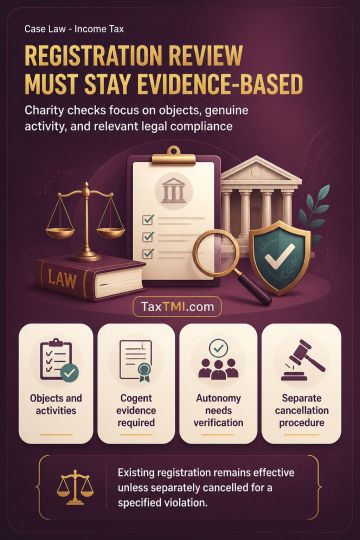
Public benefit requirement defeats charitable registration where residents' association services are reciprocal, member-only facilities governed by mu...
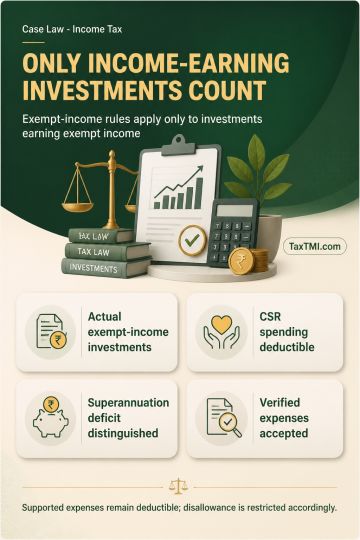
Exempt-income expenditure disallowance is confined to investments that actually generated exempt income, while supported business expenses remain dedu...
Page of 4796
Press 'Enter' after typing page number.
621 to 640 of 95918 Results
❮
❯
❯❯
0 / 200
Expand Note
Add to Folder
No Folders have been created
+
Are you sure you want to delete "My most important" ?
In a case concerning unexplained credit u/s 68, the assessee proved the identity and genuineness of share applicants, although their creditworthiness was questioned. The court held that if the assessing officer doubts creditworthiness, verification should be done in the shareholders' hands, not the assessee company's. If shareholders are identified, non-fictitious, and payments made through banking channels, no addition u/s 69 is permissible. The assessee provided ITRs, bank statements, and PAN details, proving shareholders' identity, genuineness, and creditworthiness. Regarding ad hoc expense disallowance for lack of bills/vouchers, the court observed the assessing officer failed to pinpoint specific expenses and deleted the disallowance. On share application money treated as unexplained u/s 68, the court held that for small investors investing limited amounts, creditworthiness cannot be doubted solely for non-filing of ITRs/bank statements when identity and genuineness are proved through application forms and receipts. Once shareholder identity is proved, the assessee's onus to prove the source is discharged.
In a case concerning unexplained credit u/s 68, the assessee proved the identity and genuineness of share applicants, although their creditworthiness was questioned. The court held that if the assessing officer doubts creditworthiness, verification should be done in the shareholders' hands, not the assessee company's. If shareholders are identified, non-fictitious, and payments made through banking channels, no addition u/s 69 is permissible. The assessee provided ITRs, bank statements, and PAN details, proving shareholders' identity, genuineness, and creditworthiness. Regarding ad hoc expense disallowance for lack of bills/vouchers, the court observed the assessing officer failed to pinpoint specific expenses and deleted the disallowance. On share application money treated as unexplained u/s 68, the court held that for small investors investing limited amounts, creditworthiness cannot be doubted solely for non-filing of ITRs/bank statements when identity and genuineness are proved through application forms and receipts. Once shareholder identity is proved, the assessee's onus to prove the source is discharged.
Note: It is a system-generated summary and is for quick reference only.
 TaxTMI
 of 4796





 Join Channel


 TaxTMI