Necessary-party requirements limit impleadment of independent entities, while deferred consideration does not create an appealable adverse determinati...
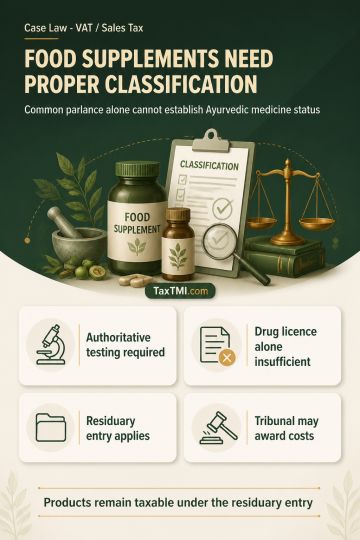
Food supplement classification requires common parlance and authoritative tests, preventing treatment as proprietary Ayurvedic medicines without suppo...
Specified regulatory authority income receives conditional tax exemption, subject to non-commercial activity, unchanged income character, and return f...
Tax exemption for regulatory authority income applies retrospectively, subject to non-commercial activity, unchanged income sources, and return-filing...
Input tax credit conditions remain constitutionally valid, with eligible recipient claims considered under GST circulars and retrospective filing dead...
The assessee-Respondent classified the aluminum circles under CTH 76069110 as raw materials, while the department proposed classification under CTH 7616, and the DRI suggested CTH 7615. The tribunal held that when revenue disputes classification, the burden is heavily on revenue to justify why the declared classification is wrong and why its proposed classification should be accepted. The revenue failed to provide evidence or dispute the assessee's contention and the chartered engineer's report that the articles were raw materials undergoing further processing. Rule 2(b) is applicable as heading 7616 does not require 'otherwise' for classification of material containing a combination of metals. Heading 7606 specifically mentions aluminum circles under 76069110, and since it is a composite product with predominant material being aluminum, by implication of Rule 2(b), it has to be classified as an aluminum circle. The department failed to make a case for interference with the First Appellate Authority's findings, and the classification of articles as confirmed in the impugned order was held to be in order. The appeal was dismissed.
The assessee-Respondent classified the aluminum circles under CTH 76069110 as raw materials, while the department proposed classification under CTH 7616, and the DRI suggested CTH 7615. The tribunal held that when revenue disputes classification, the burden is heavily on revenue to justify why the declared classification is wrong and why its proposed classification should be accepted. The revenue failed to provide evidence or dispute the assessee's contention and the chartered engineer's report that the articles were raw materials undergoing further processing. Rule 2(b) is applicable as heading 7616 does not require 'otherwise' for classification of material containing a combination of metals. Heading 7606 specifically mentions aluminum circles under 76069110, and since it is a composite product with predominant material being aluminum, by implication of Rule 2(b), it has to be classified as an aluminum circle. The department failed to make a case for interference with the First Appellate Authority's findings, and the classification of articles as confirmed in the impugned order was held to be in order. The appeal was dismissed.
Note: It is a system-generated summary and is for quick reference only.
 TaxTMI
 of 4792
















 Join Channel


 TaxTMI

