Form 26AS evidence requires successor-entity accounting verification after business transfer, while invoice-supported related-party advertising expend...
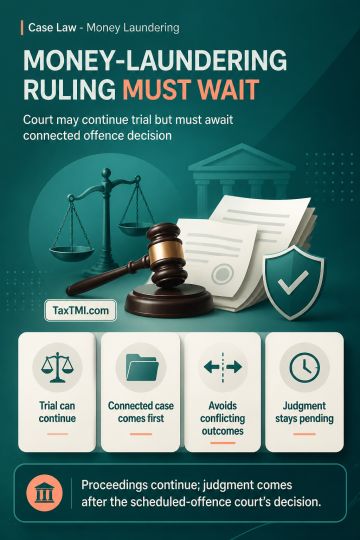
Money-laundering judgment timing requires awaiting the scheduled-offence decision despite continuation of the underlying trial where outcomes directly...
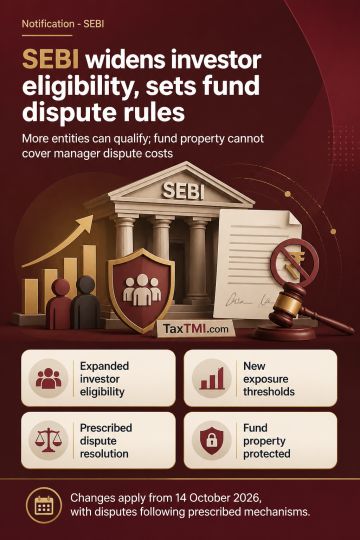
Accredited investor eligibility expands through securities-market exposure, while alternative investment fund disputes require prescribed resolution a...
Customs Assessment Portal centralises classification and valuation guidance to support consistent, transparent and informed compliance across stakehol...
Page of 4918
Press 'Enter' after typing page number.
101 to 120 of 98359 Results
❮
❯
❯❯
0 / 200
Expand Note
Add to Folder
No Folders have been created
+
Are you sure you want to delete "My most important" ?
The High Court examined a challenge against a notification issued by the Central Board of Indirect Taxes and Customs, questioning its validity u/s 168(A) of the CGST Act, 2017 due to lack of GST Council recommendation. The court found the notification prima facie inconsistent with the law, indicating potential failure of actions based on it. An assessment of force majeure applicability in light of GST Council meeting minutes was deemed necessary, with authorities given a chance to present their stance and evidence. Pending further notice, petitioners were granted interim protection against coercive measures based on the contested assessment order. Respondents were instructed to submit affidavits by a specified date for further proceedings.
The High Court examined a challenge against a notification issued by the Central Board of Indirect Taxes and Customs, questioning its validity u/s 168(A) of the CGST Act, 2017 due to lack of GST Council recommendation. The court found the notification prima facie inconsistent with the law, indicating potential failure of actions based on it. An assessment of force majeure applicability in light of GST Council meeting minutes was deemed necessary, with authorities given a chance to present their stance and evidence. Pending further notice, petitioners were granted interim protection against coercive measures based on the contested assessment order. Respondents were instructed to submit affidavits by a specified date for further proceedings.
Note: It is a system-generated summary and is for quick reference only.
 TaxTMI
  TaxTMI
 of 4918