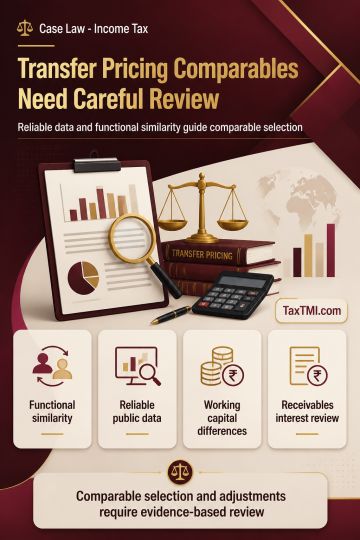
Transfer pricing comparability requires functional alignment, reliable financial data, and careful review of working capital and receivables adjustmen...
Transfer pricing rules require benchmarking corporate guarantees and associated-enterprise advances, while invalid domestic-transaction adjustments ca...
Prospective sugar export prohibition required registered letters of credit; private contracts and export quotas created no enforceable continuation ri...
Retroactive interim-moratorium exclusion permits protective asset disclosure and preservation measures against personal guarantors pending arbitration...
The High Court held that rejection of the application u/s 233 of...
Court says rejection of scheme of amalgamation application under Companies Act not justified. Govt must apply to Tribunal if scheme not in public interest.
Contents
Summary
Note
Bookmark
Share
✓ Copied successfully !
Print
Print Options
For full text, please login
Login to TaxTMI
Verification Pending
The Email Id has not been verified. Click on the link we have sent on
The High Court held that rejection of the application u/s 233 of the Companies Act, 2013, for processing a scheme of amalgamation was not justified. The Court emphasized that if the Government deems a scheme not in public interest or creditors' interest, it must apply to the Tribunal for adjudication. In this case, as the declaration of solvency was filed and the scheme was approved, respondent should have followed the prescribed procedure by making an application to the Tribunal if any condition was not satisfied. The Court found the rejection order to be legally flawed and quashed it, disposing of the petition.
The High Court held that rejection of the application u/s 233 of the Companies Act, 2013, for processing a scheme of amalgamation was not justified. The Court emphasized that if the Government deems a scheme not in public interest or creditors' interest, it must apply to the Tribunal for adjudication. In this case, as the declaration of solvency was filed and the scheme was approved, respondent should have followed the prescribed procedure by making an application to the Tribunal if any condition was not satisfied. The Court found the rejection order to be legally flawed and quashed it, disposing of the petition.
Note: It is a system-generated summary and is for quick reference only.
 TaxTMI
 of 4782
















 Join Channel


 TaxTMI