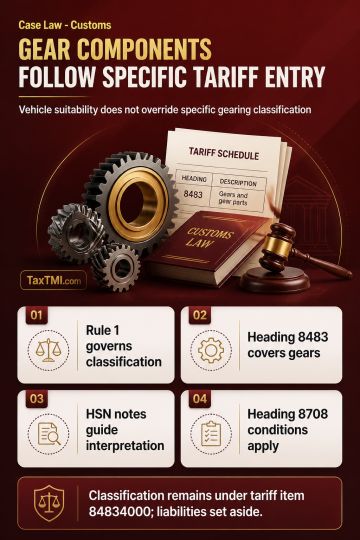
Tariff classification of vehicle gear components follows the specific gearing entry, displacing motor-vehicle parts classification and related liabili...
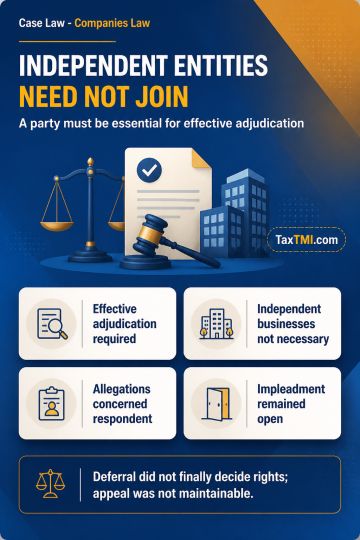
Necessary-party requirements limit impleadment of independent entities, while deferred consideration does not create an appealable adverse determinati...
Food supplement classification requires common parlance and authoritative tests, preventing treatment as proprietary Ayurvedic medicines without suppo...
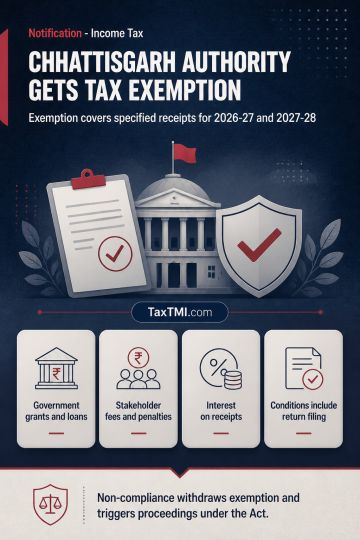
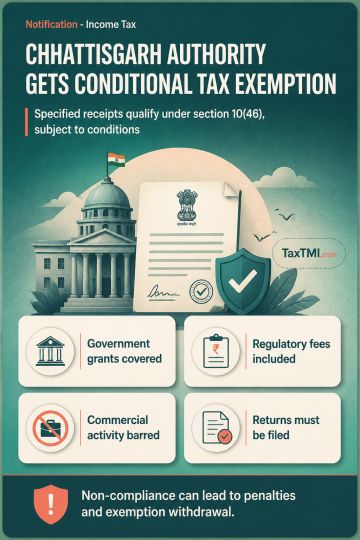
Specified regulatory authority income receives conditional tax exemption, subject to non-commercial activity, unchanged income character, and return f...
Tax exemption for regulatory authority income applies retrospectively, subject to non-commercial activity, unchanged income sources, and return-filing...
The High Court held that rejection of the application u/s 233 of...
Court says rejection of scheme of amalgamation application under Companies Act not justified. Govt must apply to Tribunal if scheme not in public interest.
Contents
Summary
Note
Bookmark
Share
✓ Copied successfully !
Print
Print Options
For full text, please login
Login to TaxTMI
Verification Pending
The Email Id has not been verified. Click on the link we have sent on
The High Court held that rejection of the application u/s 233 of the Companies Act, 2013, for processing a scheme of amalgamation was not justified. The Court emphasized that if the Government deems a scheme not in public interest or creditors' interest, it must apply to the Tribunal for adjudication. In this case, as the declaration of solvency was filed and the scheme was approved, respondent should have followed the prescribed procedure by making an application to the Tribunal if any condition was not satisfied. The Court found the rejection order to be legally flawed and quashed it, disposing of the petition.
The High Court held that rejection of the application u/s 233 of the Companies Act, 2013, for processing a scheme of amalgamation was not justified. The Court emphasized that if the Government deems a scheme not in public interest or creditors' interest, it must apply to the Tribunal for adjudication. In this case, as the declaration of solvency was filed and the scheme was approved, respondent should have followed the prescribed procedure by making an application to the Tribunal if any condition was not satisfied. The Court found the rejection order to be legally flawed and quashed it, disposing of the petition.
Note: It is a system-generated summary and is for quick reference only.
 TaxTMI
 of 4782












 Join Channel


 TaxTMI
