Authentication of paper assessment orders upheld, while qualifying repairs, consumables and vendor advance write-offs remain deductible business claim...
Transaction value cannot be rejected solely on non-statutory valuation guidelines without corroborative evidence supporting reassessment of final cust...
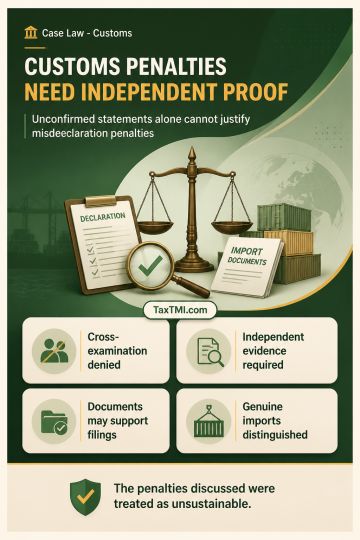
Cross-examination rights and corroborated evidence limit customs penalties for misdeclaration in genuine import transactions involving documented clea...
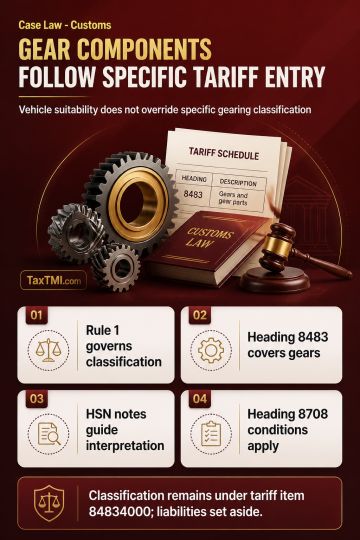
Tariff classification of vehicle gear components follows the specific gearing entry, displacing motor-vehicle parts classification and related liabili...
Page of 4786
Press 'Enter' after typing page number.
381 to 400 of 95715 Results
❮
❯
❯❯
0 / 200
Expand Note
Add to Folder
No Folders have been created
+
Are you sure you want to delete "My most important" ?
The case involves the statutory interpretation of Entry 41 of Schedule II of the Act regarding the classification of a product as a medicated ointment. The court emphasized harmonizing inclusive and exclusive clauses in legislative provisions. Entry 41 aims to classify products based on medicinal properties, with medicated ointments receiving favorable tax treatment. The use of "but" in the entry indicates an exception for medicated ointments. The Revenue failed to disprove the product's classification, highlighting the importance of meeting the burden of proof. The court cited precedents emphasizing the Assessee's favorable interpretation in charging sections. The Tribunal's classification of the product as a medicated ointment was supported by robust evidence, leading to the dismissal of revision petitions. The High Court's revisional jurisdiction is limited to questions of law, jurisdictional errors, or procedural irregularities, not factual re-inquiry. Perversity in decisions requires meeting legal thresholds with concrete evidence. The Tribunal's decision was supported by substantial evidence, justifying the dismissal of revision petitions.
The case involves the statutory interpretation of Entry 41 of Schedule II of the Act regarding the classification of a product as a medicated ointment. The court emphasized harmonizing inclusive and exclusive clauses in legislative provisions. Entry 41 aims to classify products based on medicinal properties, with medicated ointments receiving favorable tax treatment. The use of "but" in the entry indicates an exception for medicated ointments. The Revenue failed to disprove the product's classification, highlighting the importance of meeting the burden of proof. The court cited precedents emphasizing the Assessee's favorable interpretation in charging sections. The Tribunal's classification of the product as a medicated ointment was supported by robust evidence, leading to the dismissal of revision petitions. The High Court's revisional jurisdiction is limited to questions of law, jurisdictional errors, or procedural irregularities, not factual re-inquiry. Perversity in decisions requires meeting legal thresholds with concrete evidence. The Tribunal's decision was supported by substantial evidence, justifying the dismissal of revision petitions.
Note: It is a system-generated summary and is for quick reference only.
 TaxTMI
 of 4786















 Join Channel


 TaxTMI