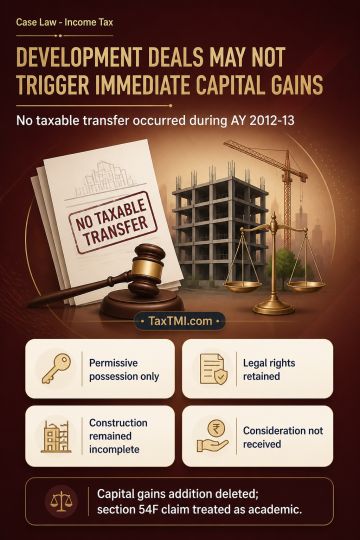
Development agreements require legal possession or effective enjoyment for capital gains transfer; permissive possession and deferred consideration de...
Prolonged sterilisation of development rights supports capital-gains treatment, while business-income disallowances cannot govern capital-gains comput...
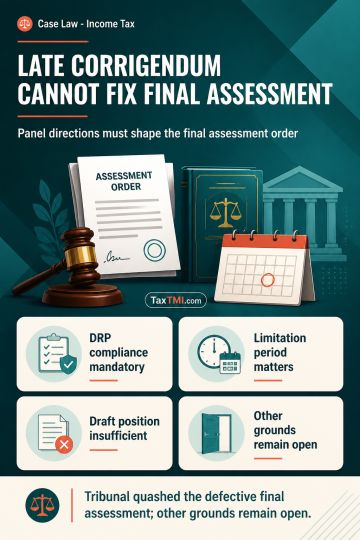
Additional evidence in transfer pricing dispute leads to fresh examination, while tax deductions, TDS credit, fee and refund interest require verifica...
Category II AIF pass-through taxation preserves non-business income character; investment receipts cannot be reclassified without applying recognised ...
Mutual fund maturity rules require proper rollover, redemption, disclosure, and due diligence; investor gains cannot excuse regulatory breaches or pen...
The case dealt with the interpretation of interest clauses in an arbitration award, specifically whether interest could be payable on interest or if the awarded 15% per annum interest would apply only to the principal sum, with an additional 12% per annum interest for the preaward period. The court held that interest is generally payable on the principal sum adjudged and not on interest. The Interest Act, 1978 prohibits courts from awarding interest upon interest unless specifically provided by statute or contract terms. The court noted that neither the Act nor Section 34 of the CPC empower the court to award compound interest. The Supreme Court declined to interfere with the lower courts' decision, dismissing the Special Leave Petition.
The case dealt with the interpretation of interest clauses in an arbitration award, specifically whether interest could be payable on interest or if the awarded 15% per annum interest would apply only to the principal sum, with an additional 12% per annum interest for the preaward period. The court held that interest is generally payable on the principal sum adjudged and not on interest. The Interest Act, 1978 prohibits courts from awarding interest upon interest unless specifically provided by statute or contract terms. The court noted that neither the Act nor Section 34 of the CPC empower the court to award compound interest. The Supreme Court declined to interfere with the lower courts' decision, dismissing the Special Leave Petition.
Note: It is a system-generated summary and is for quick reference only.
 TaxTMI
 of 4794















 Join Channel


 TaxTMI
