Statutory transfer formalities invalidated alleged share and property transfers, while retrospective record manipulation constituted oppression and mi...
Provisional attachment of laundered funds and equivalent-value property sustained, with statutory protection limited to pension, gratuity and providen...
Insolvency moratorium does not shield company officers from cheque dishonour prosecution for liability arising before corporate insolvency proceedings...
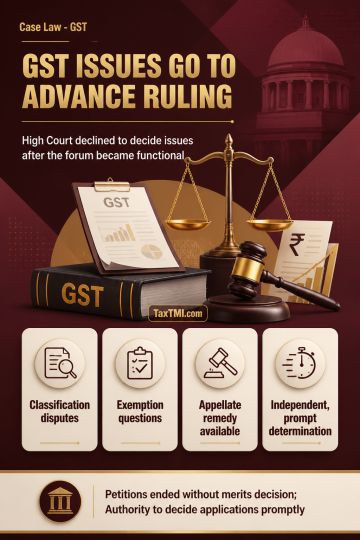
Advance-ruling mechanism governs pending GST classification, exemption and taxability disputes, limiting writ review once the specialised forum functi...
Page of 4794
Press 'Enter' after typing page number.
701 to 720 of 95872 Results
❮
❯
❯❯
0 / 200
Expand Note
Add to Folder
No Folders have been created
+
Are you sure you want to delete "My most important" ?
Consultancy charges paid to a director were disallowed u/s 40A(2). The assessee justified the payment, citing the director's expertise, experience, and reasonableness compared to the business size. The ITAT held that the AO cannot judge the expenditure's reasonableness unless proven excessive compared to market rates. The Madras High Court ruled that expenditure reasonableness must be judged from a businessman's viewpoint, not Revenue's, unless excessive payment is proven. The assessee's project started generating revenue, justifying the increased payment. The payment complied with the Companies Act, TDS was deducted, and the director offered it for tax. The AO failed to demonstrate the payment's excessiveness or unreasonableness. Merely disallowing the differential without establishing unreasonableness was incorrect. The disallowance was deleted in favor of the assessee.
Consultancy charges paid to a director were disallowed u/s 40A(2). The assessee justified the payment, citing the director's expertise, experience, and reasonableness compared to the business size. The ITAT held that the AO cannot judge the expenditure's reasonableness unless proven excessive compared to market rates. The Madras High Court ruled that expenditure reasonableness must be judged from a businessman's viewpoint, not Revenue's, unless excessive payment is proven. The assessee's project started generating revenue, justifying the increased payment. The payment complied with the Companies Act, TDS was deducted, and the director offered it for tax. The AO failed to demonstrate the payment's excessiveness or unreasonableness. Merely disallowing the differential without establishing unreasonableness was incorrect. The disallowance was deleted in favor of the assessee.
Note: It is a system-generated summary and is for quick reference only.
 TaxTMI
 of 4794

















 Join Channel


 TaxTMI