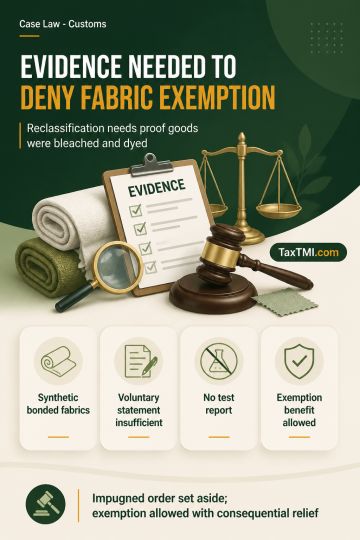
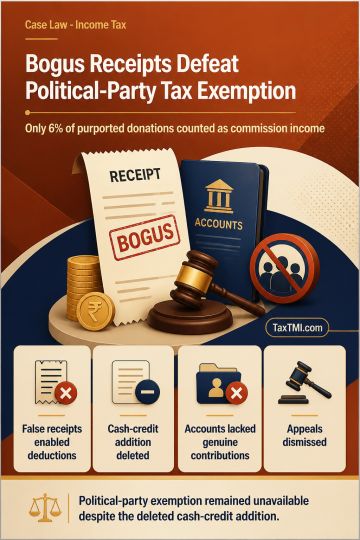
Bogus donation receipts justified commission income assessment and defeated political-party tax exemption for inaccurate accounts and reporting failur...
Pure reimbursement without income element escapes tax withholding, while delayed withholding and unsupported provisions face deferred or renewed scrut...
Public benefit requirement defeats charitable registration where residents' association services are reciprocal, member-only facilities governed by mu...
Exempt-income expenditure disallowance is confined to investments that actually generated exempt income, while supported business expenses remain dedu...
Consultancy charges paid to a director were disallowed u/s 40A(2). The assessee justified the payment, citing the director's expertise, experience, and reasonableness compared to the business size. The ITAT held that the AO cannot judge the expenditure's reasonableness unless proven excessive compared to market rates. The Madras High Court ruled that expenditure reasonableness must be judged from a businessman's viewpoint, not Revenue's, unless excessive payment is proven. The assessee's project started generating revenue, justifying the increased payment. The payment complied with the Companies Act, TDS was deducted, and the director offered it for tax. The AO failed to demonstrate the payment's excessiveness or unreasonableness. Merely disallowing the differential without establishing unreasonableness was incorrect. The disallowance was deleted in favor of the assessee.
Consultancy charges paid to a director were disallowed u/s 40A(2). The assessee justified the payment, citing the director's expertise, experience, and reasonableness compared to the business size. The ITAT held that the AO cannot judge the expenditure's reasonableness unless proven excessive compared to market rates. The Madras High Court ruled that expenditure reasonableness must be judged from a businessman's viewpoint, not Revenue's, unless excessive payment is proven. The assessee's project started generating revenue, justifying the increased payment. The payment complied with the Companies Act, TDS was deducted, and the director offered it for tax. The AO failed to demonstrate the payment's excessiveness or unreasonableness. Merely disallowing the differential without establishing unreasonableness was incorrect. The disallowance was deleted in favor of the assessee.
Note: It is a system-generated summary and is for quick reference only.
 TaxTMI
 of 4792
















 Join Channel


 TaxTMI