Authentication of paper assessment orders upheld, while qualifying repairs, consumables and vendor advance write-offs remain deductible business claim...
Transaction value cannot be rejected solely on non-statutory valuation guidelines without corroborative evidence supporting reassessment of final cust...
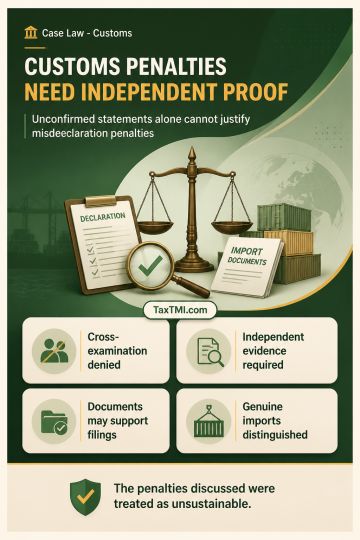
Cross-examination rights and corroborated evidence limit customs penalties for misdeclaration in genuine import transactions involving documented clea...
Tariff classification of vehicle gear components follows the specific gearing entry, displacing motor-vehicle parts classification and related liabili...
Consultancy charges paid to a director were disallowed u/s 40A(2). The assessee justified the payment, citing the director's expertise, experience, and reasonableness compared to the business size. The ITAT held that the AO cannot judge the expenditure's reasonableness unless proven excessive compared to market rates. The Madras High Court ruled that expenditure reasonableness must be judged from a businessman's viewpoint, not Revenue's, unless excessive payment is proven. The assessee's project started generating revenue, justifying the increased payment. The payment complied with the Companies Act, TDS was deducted, and the director offered it for tax. The AO failed to demonstrate the payment's excessiveness or unreasonableness. Merely disallowing the differential without establishing unreasonableness was incorrect. The disallowance was deleted in favor of the assessee.
Consultancy charges paid to a director were disallowed u/s 40A(2). The assessee justified the payment, citing the director's expertise, experience, and reasonableness compared to the business size. The ITAT held that the AO cannot judge the expenditure's reasonableness unless proven excessive compared to market rates. The Madras High Court ruled that expenditure reasonableness must be judged from a businessman's viewpoint, not Revenue's, unless excessive payment is proven. The assessee's project started generating revenue, justifying the increased payment. The payment complied with the Companies Act, TDS was deducted, and the director offered it for tax. The AO failed to demonstrate the payment's excessiveness or unreasonableness. Merely disallowing the differential without establishing unreasonableness was incorrect. The disallowance was deleted in favor of the assessee.
Note: It is a system-generated summary and is for quick reference only.
 TaxTMI
 of 4792



















 Join Channel


 TaxTMI