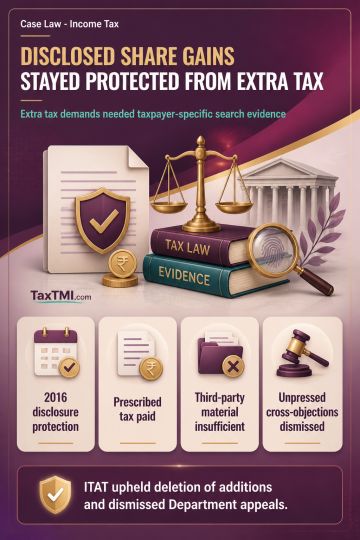
Income Disclosure Scheme immunity and search-material requirements barred further share-transaction additions in unabated assessments under section 15...
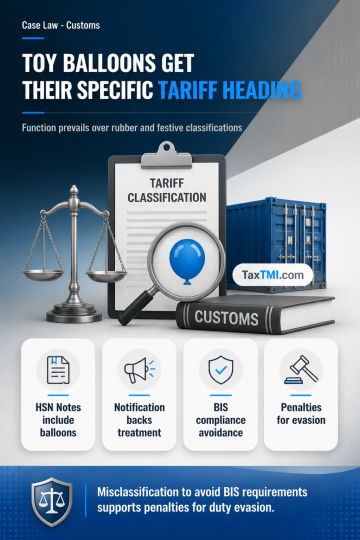
Toy balloon tariff classification: functional heading prevails over residual rubber and festive article headings, supporting penalties for deliberate ...
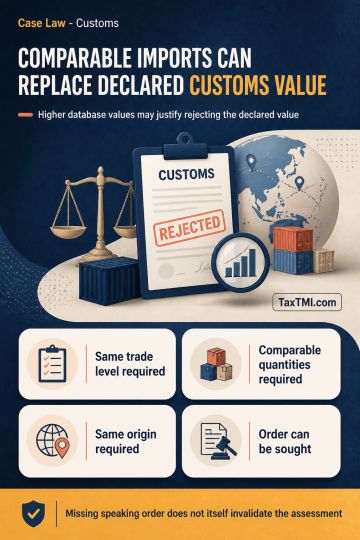
Customs valuation using comparable contemporaneous imports can displace declared value, while missing speaking orders require pursuit before competent...
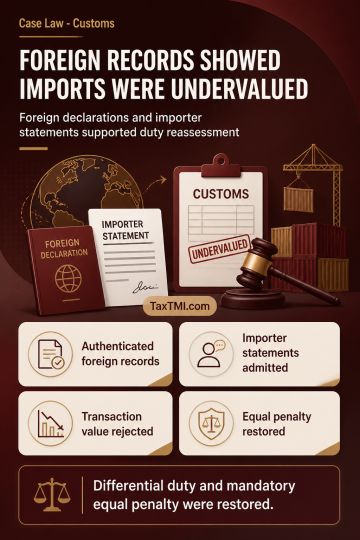
Foreign customs declarations and importer admissions established undervaluation, supporting sequential value redetermination, differential duty, and m...
Page of 4821
Press 'Enter' after typing page number.
201 to 220 of 96406 Results
❮
❯
❯❯
0 / 200
Expand Note
Add to Folder
No Folders have been created
+
Are you sure you want to delete "My most important" ?
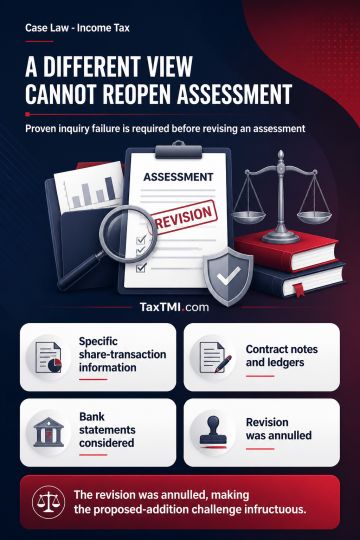
The ITAT held that the Assessing Officer (AO) had incorrectly assumed facts while reopening the assessment u/s 147, leading to an erroneous belief of income escaping assessment. The assessee had already undergone scrutiny assessment u/s 143(3), disclosed share application receipts, and provided relevant details accepted by the AO. Despite adverse information from the CIT(A), the AO failed to conduct a preliminary inquiry and relied on incorrect assumptions. Mere adverse information triggers 'reason to suspect' but not the 'reason to believe' required for reopening assessment. The AO did not record proper reasons after examining material. Consequently, the notice issued u/s 148 was vitiated, held bad in law, and quashed by the ITAT, allowing the assessee's appeal.
The ITAT held that the Assessing Officer (AO) had incorrectly assumed facts while reopening the assessment u/s 147, leading to an erroneous belief of income escaping assessment. The assessee had already undergone scrutiny assessment u/s 143(3), disclosed share application receipts, and provided relevant details accepted by the AO. Despite adverse information from the CIT(A), the AO failed to conduct a preliminary inquiry and relied on incorrect assumptions. Mere adverse information triggers 'reason to suspect' but not the 'reason to believe' required for reopening assessment. The AO did not record proper reasons after examining material. Consequently, the notice issued u/s 148 was vitiated, held bad in law, and quashed by the ITAT, allowing the assessee's appeal.
Note: It is a system-generated summary and is for quick reference only.
 TaxTMI
  TaxTMI
 of 4821









 Join Channel