Charitable registration renewal cannot become an assessment of receipts, profitability or annual exemption compliance, requiring renewal and donation ...
AMP expenditure for own business is not an international transaction without an associated-enterprise arrangement, eliminating transfer pricing adjust...
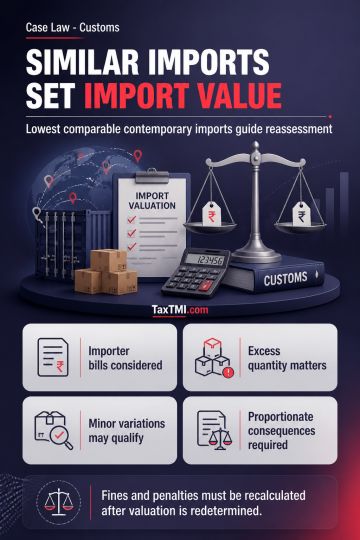
Customs valuation must use comparable contemporary imports, while confiscation fines and penalties require proportionate recalculation on reassessed v...
Depositor-protection proceedings prevail over corporate insolvency, while liquidators may recover chit receivables using copies of seized company reco...
Intermediary service classification fails where overseas admission facilitation is supplied independently, preserving export treatment and small-provi...
Page of 4826
Press 'Enter' after typing page number.
481 to 500 of 96504 Results
❮
❯
❯❯
0 / 200
Expand Note
Add to Folder
No Folders have been created
+
Are you sure you want to delete "My most important" ?
The key aspects of the case relate to the maintainability of an application before the Advance Ruling Authority, classification of imported goods, and the applicability of Rule 2(a) for determining the classification. The court held that the expression "business" in Section 28E(a) of the Customs Act must be given a wide meaning, encompassing business models/modus operandi, not just products. The change in the applicant's business model constituted an "activity" for the purpose of Section 28E, rendering the application maintainable. Regarding classification, the court reiterated that until all components of a complete article are presented together for assessment, Rule 2(a) cannot be invoked to classify the parts as a complete article. As six essential components were procured from Indian vendors, the imports could not be classified as motor vehicles u/r 2(a). Consequently, the court dismissed the writ petition, upholding the impugned order.
The key aspects of the case relate to the maintainability of an application before the Advance Ruling Authority, classification of imported goods, and the applicability of Rule 2(a) for determining the classification. The court held that the expression "business" in Section 28E(a) of the Customs Act must be given a wide meaning, encompassing business models/modus operandi, not just products. The change in the applicant's business model constituted an "activity" for the purpose of Section 28E, rendering the application maintainable. Regarding classification, the court reiterated that until all components of a complete article are presented together for assessment, Rule 2(a) cannot be invoked to classify the parts as a complete article. As six essential components were procured from Indian vendors, the imports could not be classified as motor vehicles u/r 2(a). Consequently, the court dismissed the writ petition, upholding the impugned order.
Note: It is a system-generated summary and is for quick reference only.
 TaxTMI
  TaxTMI
 of 4826



















 Join Channel