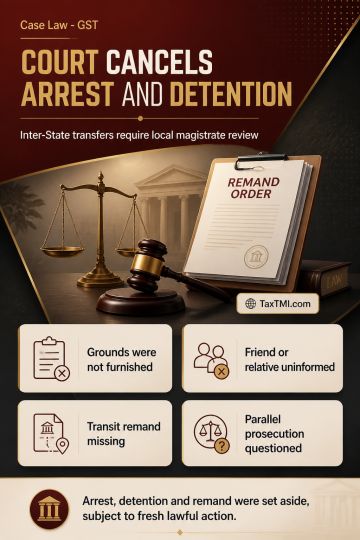
Arrest safeguards and transit remand requirements invalidated detention following inter-State transfer without communicated grounds or magistrate auth...
Arrest safeguards require disclosed grounds, relative intimation and transit remand, while duplicate prosecution under the CGST framework is unsustain...
Document Identification Number defects can invalidate GST assessments, with delayed challenges entertained conditionally where patent irregularities e...
Windmill commissioning evidence supported higher depreciation where grid connection and electricity generation proved operational use before the relev...
The assessee company was denied exemption under Article 13(3B) and 13(4) of the India-Mauritius Treaty, and its capital gains from sale of shares, futures, and options were taxed, as its control and management were found to lie outside Mauritius in UAE, with the beneficial owner being a UAE resident. However, the CIT(A) held the assessee eligible for the India-Mauritius treaty benefit. The ITAT upheld the CIT(A)'s decision, finding no conclusive evidence that the assessee's control and management were outside Mauritius or that the beneficial owner was a UAE resident. The assessee had Mauritius-resident directors, held board meetings in Mauritius, had a valid TRC, Category 1 Global Business License, and SEBI registration, proving its Mauritius tax residency. The protocol amending the treaty was not applicable as it had not come into force. The ITAT relied on Supreme Court's Azadi Bachao Andolan case principles and CBDT Circular 789/2000 while interpreting the treaty.
The assessee company was denied exemption under Article 13(3B) and 13(4) of the India-Mauritius Treaty, and its capital gains from sale of shares, futures, and options were taxed, as its control and management were found to lie outside Mauritius in UAE, with the beneficial owner being a UAE resident. However, the CIT(A) held the assessee eligible for the India-Mauritius treaty benefit. The ITAT upheld the CIT(A)'s decision, finding no conclusive evidence that the assessee's control and management were outside Mauritius or that the beneficial owner was a UAE resident. The assessee had Mauritius-resident directors, held board meetings in Mauritius, had a valid TRC, Category 1 Global Business License, and SEBI registration, proving its Mauritius tax residency. The protocol amending the treaty was not applicable as it had not come into force. The ITAT relied on Supreme Court's Azadi Bachao Andolan case principles and CBDT Circular 789/2000 while interpreting the treaty.
Note: It is a system-generated summary and is for quick reference only.
 TaxTMI
  TaxTMI
 of 4814













 Join Channel


