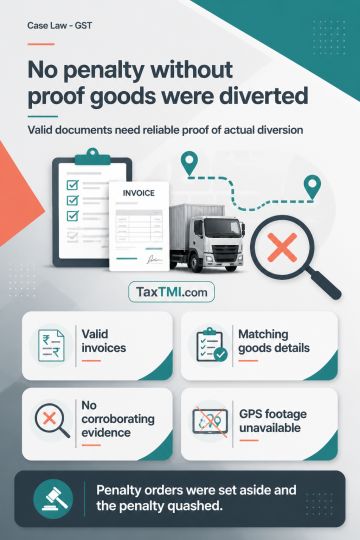
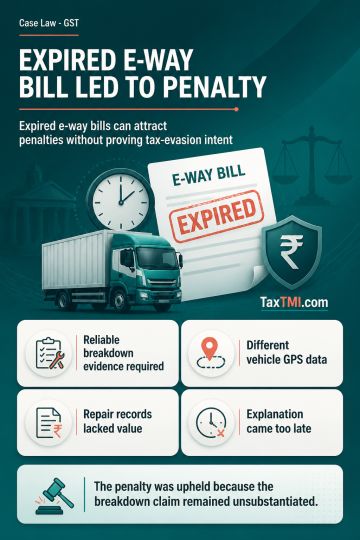
Delayed transport documents failed to validate intercepted goods, sustaining transit-state penalties where the claimed interstate destination remained...
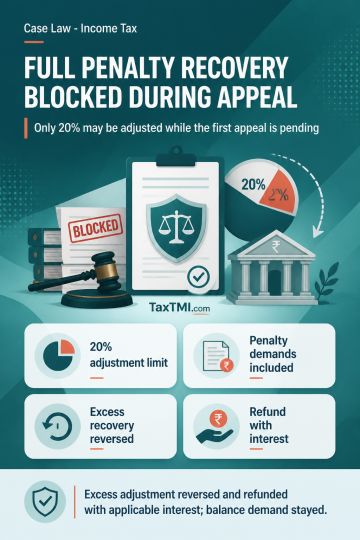
Penalty u/s 271(c) was imposed on additions of 25% of non-verifiable purchases debited to the trading account. The addition was made on estimation of total turnover after rejecting the books of accounts. Notices u/s 133(6) were issued to various purchase parties, but all were returned by the postal authority, and the assessee did not produce the parties to confirm the same. The lower authorities observed that the revenue did not establish that the assessee had concealed or submitted inaccurate particulars of income to attract Section 271(1)(c). The addition was admittedly made on an estimate basis. The ratio of the judgment in Parasamal Babulal Jain and various ITAT pronouncements covered the assessee's case. Since the addition was made on an estimate basis, the penalty was rightly deleted by the CIT(A). The ITAT found no illegality in the CIT(A)'s order and confirmed it, deciding against the revenue.
Penalty u/s 271(c) was imposed on additions of 25% of non-verifiable purchases debited to the trading account. The addition was made on estimation of total turnover after rejecting the books of accounts. Notices u/s 133(6) were issued to various purchase parties, but all were returned by the postal authority, and the assessee did not produce the parties to confirm the same. The lower authorities observed that the revenue did not establish that the assessee had concealed or submitted inaccurate particulars of income to attract Section 271(1)(c). The addition was admittedly made on an estimate basis. The ratio of the judgment in Parasamal Babulal Jain and various ITAT pronouncements covered the assessee's case. Since the addition was made on an estimate basis, the penalty was rightly deleted by the CIT(A). The ITAT found no illegality in the CIT(A)'s order and confirmed it, deciding against the revenue.
Note: It is a system-generated summary and is for quick reference only.
 TaxTMI
  TaxTMI
 of 4921