Form 26AS evidence requires successor-entity accounting verification after business transfer, while invoice-supported related-party advertising expend...
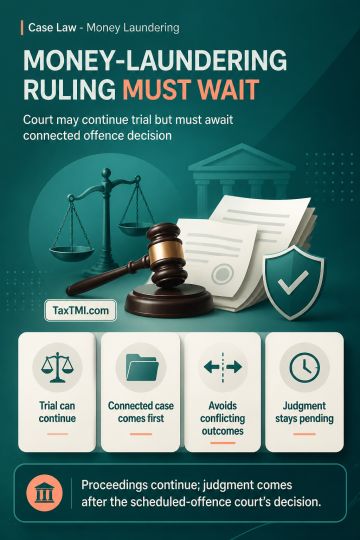
Money-laundering judgment timing requires awaiting the scheduled-offence decision despite continuation of the underlying trial where outcomes directly...
Accredited investor eligibility expands through securities-market exposure, while alternative investment fund disputes require prescribed resolution a...
Customs Assessment Portal centralises classification and valuation guidance to support consistent, transparent and informed compliance across stakehol...
Page of 4918
Press 'Enter' after typing page number.
101 to 120 of 98359 Results
❮
❯
❯❯
0 / 200
Expand Note
Add to Folder
No Folders have been created
+
Are you sure you want to delete "My most important" ?
The court held that the Registrar of Companies (ROC) had the power to strike off the name of a company from the Register u/s 560(1)(6) of the old Companies Act, 1956, which is pari materia with Section 248 of the new Companies Act, 2013. The provisions under the old and new Acts are consistent, with the new Act providing a more detailed procedure for striking off and an effective remedy for dealing with deregistration of non-operational companies. The registers maintained under the old Act are deemed to be maintained under the new Act. The petitioner's remedy lies with the National Company Law Tribunal under Chapter XXVII of the Companies Act, 2013. Therefore, the application was dismissed.
The court held that the Registrar of Companies (ROC) had the power to strike off the name of a company from the Register u/s 560(1)(6) of the old Companies Act, 1956, which is pari materia with Section 248 of the new Companies Act, 2013. The provisions under the old and new Acts are consistent, with the new Act providing a more detailed procedure for striking off and an effective remedy for dealing with deregistration of non-operational companies. The registers maintained under the old Act are deemed to be maintained under the new Act. The petitioner's remedy lies with the National Company Law Tribunal under Chapter XXVII of the Companies Act, 2013. Therefore, the application was dismissed.
Note: It is a system-generated summary and is for quick reference only.
 TaxTMI
  TaxTMI
 of 4918