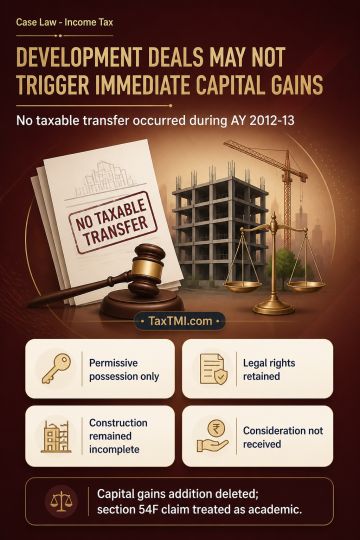
Development agreements require legal possession or effective enjoyment for capital gains transfer; permissive possession and deferred consideration de...
Prolonged sterilisation of development rights supports capital-gains treatment, while business-income disallowances cannot govern capital-gains comput...
Additional evidence in transfer pricing dispute leads to fresh examination, while tax deductions, TDS credit, fee and refund interest require verifica...
Category II AIF pass-through taxation preserves non-business income character; investment receipts cannot be reclassified without applying recognised ...
Page of 4814
Press 'Enter' after typing page number.
1461 to 1480 of 96262 Results
❮
❯
❯❯
0 / 200
Expand Note
Add to Folder
No Folders have been created
+
Are you sure you want to delete "My most important" ?
The appellant was issued penalty u/r 26(2) of Central Excise Rules, 2002, alleging that second stage dealers based in Jaipur were issuing cenvatable invoices to the main noticee without delivering goods, which were purchased from first stage dealers and manufactured by non-existent or non-working manufacturers. The Commissioner (Appeals) recorded categorical findings that the main noticee had duly received goods and made duty payment. Tribunal held that when the demand for cenvat credit itself is not maintainable, there is no justification to affirm penalty on the appellant. Following the principles enunciated by Division Bench in Drolia Electrosteel case, where department accepted findings of Commissioner (Appeals), there is no justification to uphold penalty imposition on appellant. The impugned order was set aside and appeal allowed.
The appellant was issued penalty u/r 26(2) of Central Excise Rules, 2002, alleging that second stage dealers based in Jaipur were issuing cenvatable invoices to the main noticee without delivering goods, which were purchased from first stage dealers and manufactured by non-existent or non-working manufacturers. The Commissioner (Appeals) recorded categorical findings that the main noticee had duly received goods and made duty payment. Tribunal held that when the demand for cenvat credit itself is not maintainable, there is no justification to affirm penalty on the appellant. Following the principles enunciated by Division Bench in Drolia Electrosteel case, where department accepted findings of Commissioner (Appeals), there is no justification to uphold penalty imposition on appellant. The impugned order was set aside and appeal allowed.
Note: It is a system-generated summary and is for quick reference only.
 TaxTMI
  TaxTMI
 of 4814













 Join Channel




