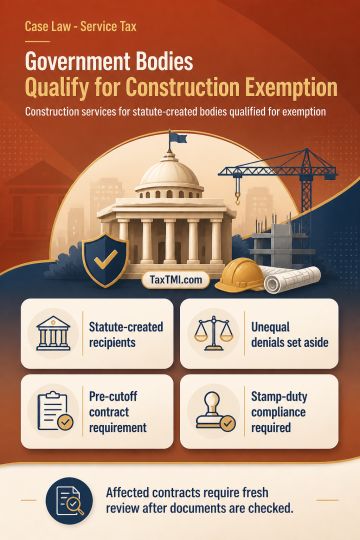
Governmental authority status supports construction-service exemption, while pre-cutoff contract and stamp-duty compliance requires verification on re...
Automated Free Sale and Commerce Certificates enable paperless processing while retaining risk-based manual verification for selected exporter applica...
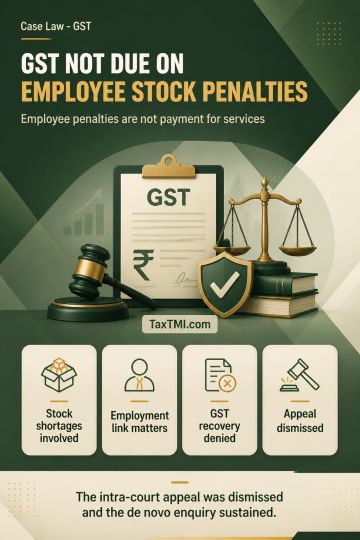
Employee stock-shortage penalties do not constitute consideration for services, preventing GST collection under Schedule II in employment relationship...
The Assessing Officer (AO) initiated reassessment proceedings u/s 147/148 against the assessee based on documents seized from the premises of J.K. Jain during a CBI search. The ITAT found that the AO passed the final reassessment order on the dictates and directions of superior authorities, compromising the independent exercise of quasi-judicial powers. The AO sought guidance from superiors at every stage, even drafting the questionnaire and skeleton order on their instructions. The proceedings were vitiated as the AO discussed the merits and conducted the proceedings under influence, contrary to the requirement of acting judicially and independently. The HC upheld the ITAT's findings, concluding that the reassessment order was the outcome of bias, as it was passed on dictation from higher authorities. Furthermore, the delay in framing the reassessment order exceeded the statutory limitation u/s 153.
The Assessing Officer (AO) initiated reassessment proceedings u/s 147/148 against the assessee based on documents seized from the premises of J.K. Jain during a CBI search. The ITAT found that the AO passed the final reassessment order on the dictates and directions of superior authorities, compromising the independent exercise of quasi-judicial powers. The AO sought guidance from superiors at every stage, even drafting the questionnaire and skeleton order on their instructions. The proceedings were vitiated as the AO discussed the merits and conducted the proceedings under influence, contrary to the requirement of acting judicially and independently. The HC upheld the ITAT's findings, concluding that the reassessment order was the outcome of bias, as it was passed on dictation from higher authorities. Furthermore, the delay in framing the reassessment order exceeded the statutory limitation u/s 153.
Note: It is a system-generated summary and is for quick reference only.
 TaxTMI
  TaxTMI
 of 4828













 Join Channel


