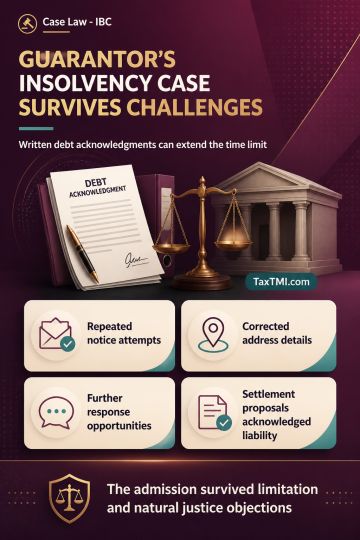
Service of notice and contractual debt acknowledgment preserved insolvency admission against a corporate guarantor despite limitation and natural just...
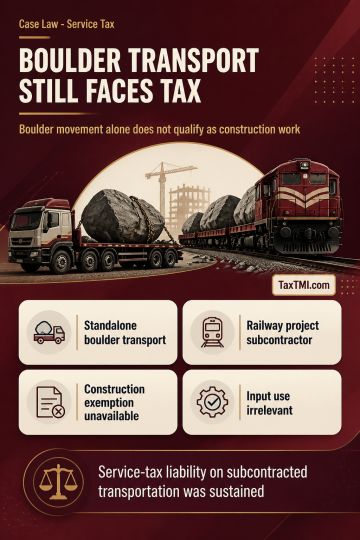
Original works exemption excludes standalone boulder transportation, leaving subcontracted railway-project transport services subject to service tax l...
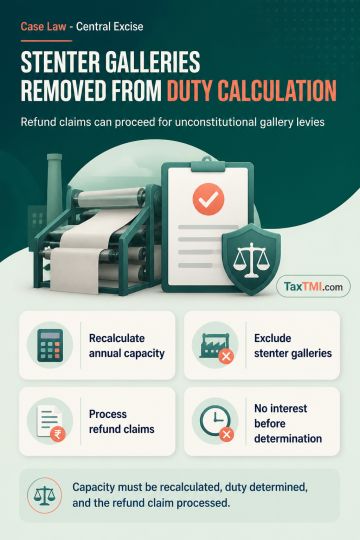
Annual production capacity determinations excluding stenter galleries support refunds for unconstitutional excise levies without an unjust-enrichment ...
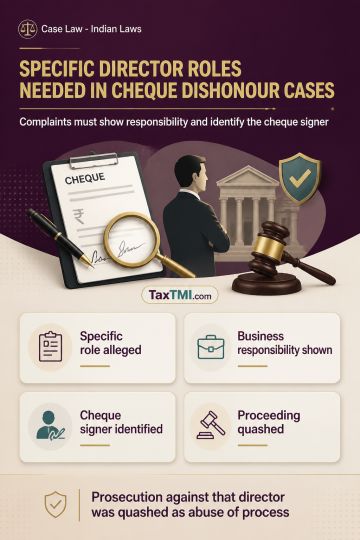
Vicarious liability for cheque dishonour requires specific allegations of responsibility and cheque signatory; generic director allegations cannot sus...
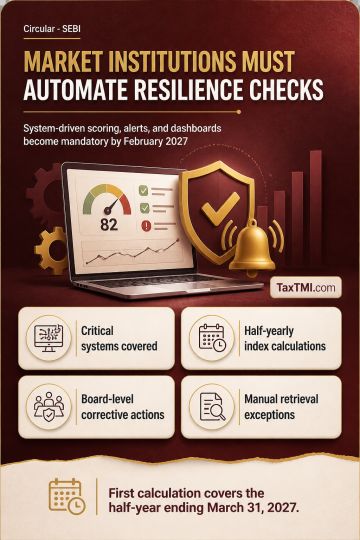
IT Resilience Index requires market infrastructure institutions to automate resilience scoring, early warnings, and continuous service-delivery monito...
The High Court addressed the issue of criminal liability in a...
High Court clarifies: Individuals in charge of company can be held liable in cheque dishonor cases. Legal responsibility upheld u/ss 138 and 141 of NI Act.
Contents
Summary
Note
Bookmark
Share
✓ Copied successfully !
Print
Print Options
For full text, please login
Login to TaxTMI
Verification Pending
The Email Id has not been verified. Click on the link we have sent on
The High Court addressed the issue of criminal liability in a cheque dishonor case involving a company. The complainant failed to specify the authorized signatory or the person in charge of daily affairs. Referring to a Supreme Court ruling, it was established that individuals responsible for a company's affairs can be summoned and penalized u/s 138 with Section 141 of NI Act. The complainant asserted that the accused were fully responsible for the company's operations, shifting the burden to the accused to prove any restrictions on their powers. The court found no flaws in summoning the accused, dismissing the petition.
The High Court addressed the issue of criminal liability in a cheque dishonor case involving a company. The complainant failed to specify the authorized signatory or the person in charge of daily affairs. Referring to a Supreme Court ruling, it was established that individuals responsible for a company's affairs can be summoned and penalized u/s 138 with Section 141 of NI Act. The complainant asserted that the accused were fully responsible for the company's operations, shifting the burden to the accused to prove any restrictions on their powers. The court found no flaws in summoning the accused, dismissing the petition.
Note: It is a system-generated summary and is for quick reference only.
 TaxTMI
  TaxTMI
 of 4828






 Join Channel