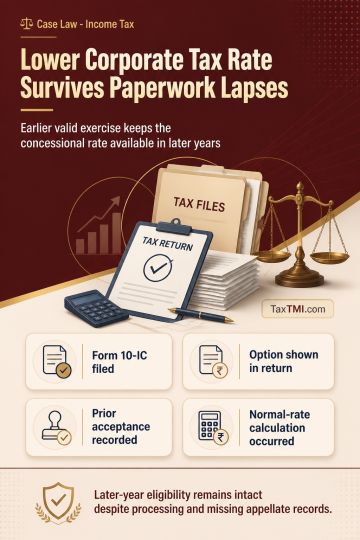
Concessional corporate tax option under section 115BAA survives procedural documentary lapses when statutory compliance and earlier exercise are estab...
Penny-stock additions require transaction-specific evidence; general investigation material alone cannot establish undisclosed income or accommodation...
Transfer pricing comparability prioritises reliable external CUPs and foreign-currency LIBOR benchmarks for exports, borrowings and delayed receivable...
Section 153C satisfaction and seized electronic records sustained unexplained-investment addition, subject to proportionate ownership-share verificati...
The High Court held that prosecution u/ss 276C, 277, 278B, and 278E for tax evasion was invalid as it violated CBDT guidelines. Prosecution was premature without the penalty confirmed by ITAT, against the instructions. The CBDT policy requires processing for prosecution only after a penalty exceeding Rs. 50,000 is confirmed. As the ITAT set aside the penalty, prosecution was deemed unwarranted. Mens rea is essential for prosecution, and since ITAT deleted the penalty, continuing prosecution was unjust. The Supreme Court precedent establishes that penalty and prosecution go together; when penalty is deleted, prosecution cannot proceed. With no appeal filed against the ITAT order, prosecution was barred by finality. Following a SC ruling, exoneration in departmental proceedings leads to the failure of criminal prosecution. Petitions were allowed.
The High Court held that prosecution u/ss 276C, 277, 278B, and 278E for tax evasion was invalid as it violated CBDT guidelines. Prosecution was premature without the penalty confirmed by ITAT, against the instructions. The CBDT policy requires processing for prosecution only after a penalty exceeding Rs. 50,000 is confirmed. As the ITAT set aside the penalty, prosecution was deemed unwarranted. Mens rea is essential for prosecution, and since ITAT deleted the penalty, continuing prosecution was unjust. The Supreme Court precedent establishes that penalty and prosecution go together; when penalty is deleted, prosecution cannot proceed. With no appeal filed against the ITAT order, prosecution was barred by finality. Following a SC ruling, exoneration in departmental proceedings leads to the failure of criminal prosecution. Petitions were allowed.
Note: It is a system-generated summary and is for quick reference only.
 TaxTMI
  TaxTMI
 of 4830















 Join Channel


