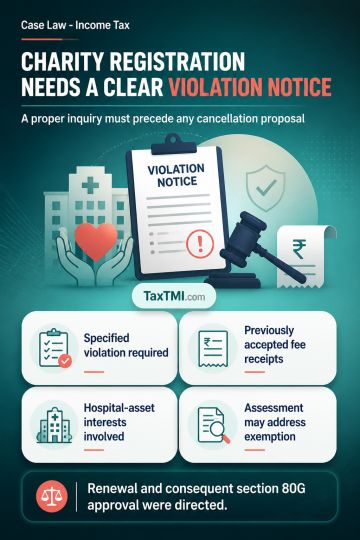
Charitable trust registration requires a specified-violation notice; settled cash deposits and related-party payments did not justify cancellation or ...
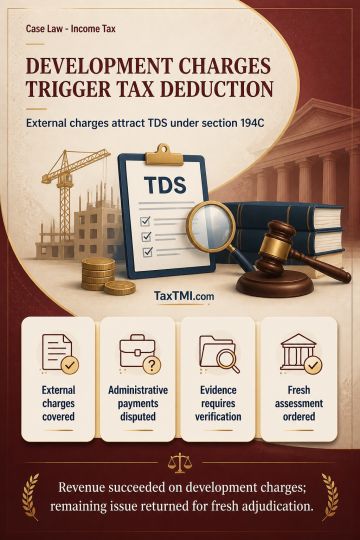
External development charges trigger TDS under section 194C, while disputed administrative payments require factual verification and fresh adjudicatio...
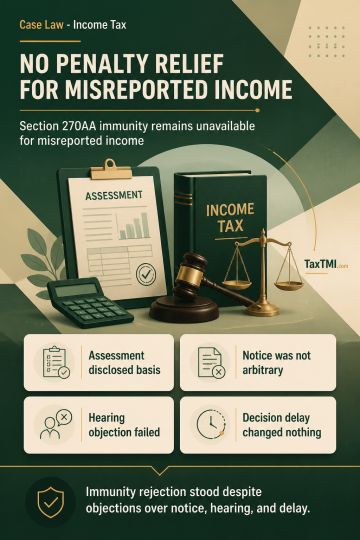
Section 270AA penalty immunity requires identified statutory defaults and a hearing before rejection; reassessment disclosure may constitute under-rep...
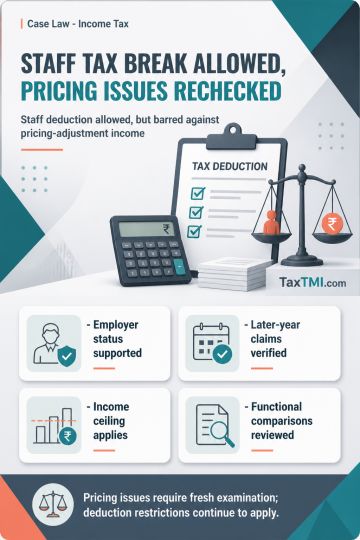
Section 80JJAA employee-cost deduction allowed for deployed staff but barred against transfer-pricing income enhancement, with pricing issues remanded...
Page of 4830
Press 'Enter' after typing page number.
141 to 160 of 96587 Results
❮
❯
❯❯
0 / 200
Expand Note
Add to Folder
No Folders have been created
+
Are you sure you want to delete "My most important" ?
The case involved a dispute over penalty imposition u/ss...
Levy of penalty against estimated income: ITAT rules penalty invalid due to inconsistent grounds for imposition. Precedents cited. Assessee's appeal allowed.
Contents
Summary
Note
Bookmark
Share
✓ Copied successfully !
Print
Print Options
For full text, please login
Login to TaxTMI
Verification Pending
The Email Id has not been verified. Click on the link we have sent on
The case involved a dispute over penalty imposition u/ss 271(1)(c) versus 271(1B) for additions related to estimated income from share trading transactions. The assessing officer initially alleged 'furnishing inaccurate particulars of income' under 271(1)(c) but later changed the basis for penalty imposition. The Tribunal held that the penalty order was invalid as the AO's satisfaction for penalty imposition was not consistent, citing precedents like New Sorathia Engineering and CIT vs. Manu Engineering Works. The Tribunal ruled that when the AO confirms penalty on a different ground than the original satisfaction under 271(1B), the penalty under 271(1)(c) is not legally sustainable. Consequently, the appeal of the assessee was allowed.
The case involved a dispute over penalty imposition u/ss 271(1)(c) versus 271(1B) for additions related to estimated income from share trading transactions. The assessing officer initially alleged 'furnishing inaccurate particulars of income' under 271(1)(c) but later changed the basis for penalty imposition. The Tribunal held that the penalty order was invalid as the AO's satisfaction for penalty imposition was not consistent, citing precedents like New Sorathia Engineering and CIT vs. Manu Engineering Works. The Tribunal ruled that when the AO confirms penalty on a different ground than the original satisfaction under 271(1B), the penalty under 271(1)(c) is not legally sustainable. Consequently, the appeal of the assessee was allowed.
Note: It is a system-generated summary and is for quick reference only.
 TaxTMI
  TaxTMI
 of 4830














 Join Channel


