Defined public benefit can retain charitable character; registration renewal requires examining genuine activities and legal compliance, not surplus a...
Capital reduction is distinct from share buy-back, preventing buy-back tax; restructuring interest and related business deductions also survive scruti...
Transfer pricing and tax deductions upheld on established principles, while employee contributions and warranty provisions returned for fresh examinat...
Captive transfer pricing relies on industrial consumer tariffs, while genuine quotations can benchmark effluent treatment transfers under the Other Me...
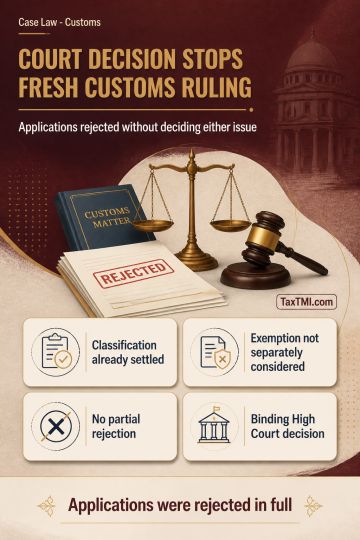
Specific tariff classification for ophthalmic instruments and extended limitation principles determine the treatment of duty demands, confiscation, an...
Integrated golf function determines classification, placing launch monitors and simulators under other golf equipment rather than measuring instrument...
The High Court considered the maintainability of a review petition based on a subsequent judgment and the condonation of a 619-day delay in filing the civil review petition. The appellant attributed the delay to the Counsel's actions. The main issue was the entitlement of exemption u/s 80-P(2)(a)(i) and the taxability of transfer charges received by the Samiti. The Court referred to a Supreme Court decision regarding the nature of transfer charges. The Court held that a decision based on a question of law, if subsequently reversed or modified by a superior court, does not form grounds for review. The Court noted a split verdict in another Supreme Court case. The Court emphasized that entertaining a review petition ignoring statutory provisions would create uncertainty. Consequently, the appeal for condonation of the delay in filing the civil review petition was dismissed.
The High Court considered the maintainability of a review petition based on a subsequent judgment and the condonation of a 619-day delay in filing the civil review petition. The appellant attributed the delay to the Counsel's actions. The main issue was the entitlement of exemption u/s 80-P(2)(a)(i) and the taxability of transfer charges received by the Samiti. The Court referred to a Supreme Court decision regarding the nature of transfer charges. The Court held that a decision based on a question of law, if subsequently reversed or modified by a superior court, does not form grounds for review. The Court noted a split verdict in another Supreme Court case. The Court emphasized that entertaining a review petition ignoring statutory provisions would create uncertainty. Consequently, the appeal for condonation of the delay in filing the civil review petition was dismissed.
Note: It is a system-generated summary and is for quick reference only.
 TaxTMI
 of 4798





















 Join Channel


 TaxTMI
