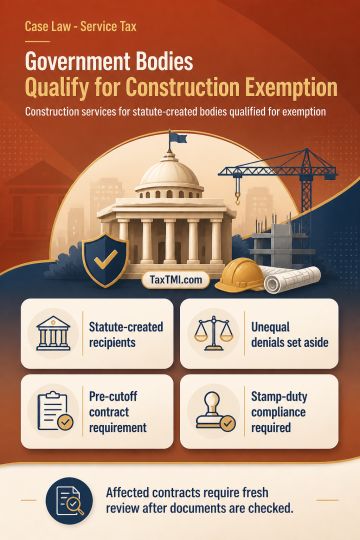
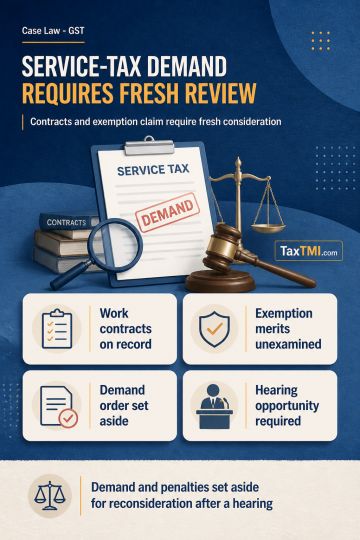
Governmental authority status supports construction-service exemption, while pre-cutoff contract and stamp-duty compliance requires verification on re...
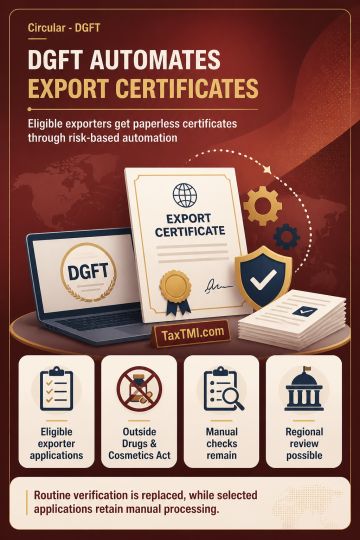
Automated Free Sale and Commerce Certificates enable paperless processing while retaining risk-based manual verification for selected exporter applica...
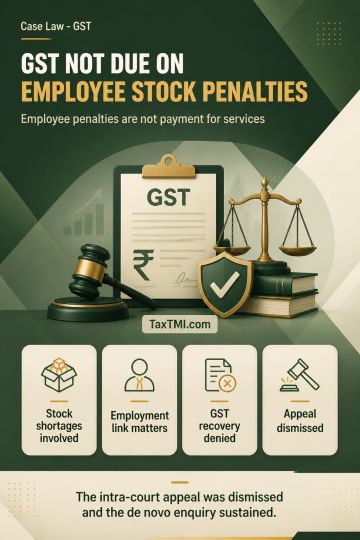
Employee stock-shortage penalties do not constitute consideration for services, preventing GST collection under Schedule II in employment relationship...
The circular addresses the Reduction of Government Litigation by setting monetary limits for filing appeals before GSTAT, High Courts, and Supreme Court. It refers to the National Litigation Policy, emphasizing prudent litigation practices. The circular cites Section 120 of the CGST Act, empowering the Central Board of Indirect Taxes & Customs to fix monetary limits for appeals. The circular sets monetary limits for filing appeals: GSTAT - 20,00,000/-, High Court - 1,00,00,000/-, and Supreme Court - 2,00,00,000/-. It outlines principles for determining if a case falls within these limits and specifies exclusions where monetary limits do not apply. It highlights that filing an appeal should be based on case merits, not just exceeding monetary limits, to reduce unnecessary litigation. Non-filing of appeals based on monetary limits does not set a precedent value. The circular encourages officers to decide on appeals based on reducing litigation and providing certainty to taxpayers.
The circular addresses the Reduction of Government Litigation by setting monetary limits for filing appeals before GSTAT, High Courts, and Supreme Court. It refers to the National Litigation Policy, emphasizing prudent litigation practices. The circular cites Section 120 of the CGST Act, empowering the Central Board of Indirect Taxes & Customs to fix monetary limits for appeals. The circular sets monetary limits for filing appeals: GSTAT - 20,00,000/-, High Court - 1,00,00,000/-, and Supreme Court - 2,00,00,000/-. It outlines principles for determining if a case falls within these limits and specifies exclusions where monetary limits do not apply. It highlights that filing an appeal should be based on case merits, not just exceeding monetary limits, to reduce unnecessary litigation. Non-filing of appeals based on monetary limits does not set a precedent value. The circular encourages officers to decide on appeals based on reducing litigation and providing certainty to taxpayers.
Note: It is a system-generated summary and is for quick reference only.
 TaxTMI
  TaxTMI
 of 4828



 Join Channel


