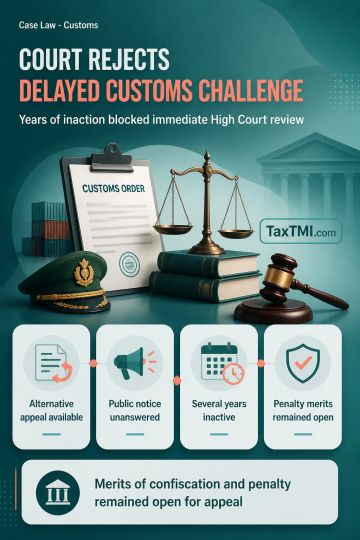
Alternative statutory remedy and unexplained delay barred writ review of customs confiscation adjudication, leaving merits for appellate consideration...
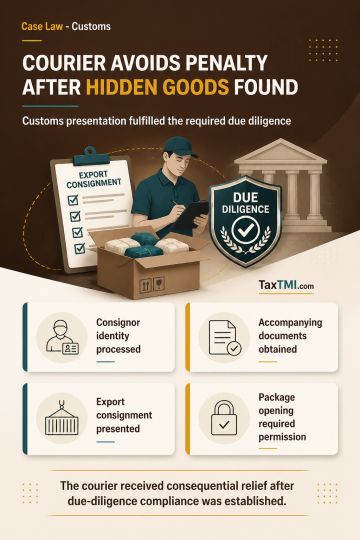
Authorised courier due diligence protects against penalties where declared exports conceal prohibited goods despite proper documentation and customs p...
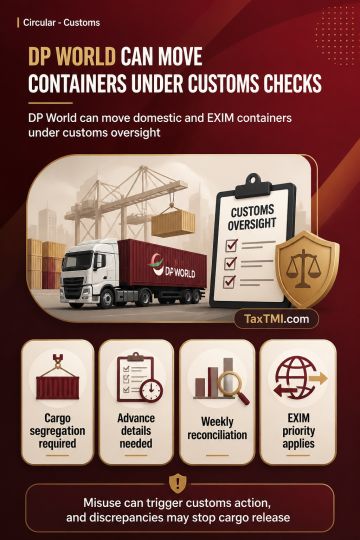
Customs-controlled container movement now extends to DP World facilities, subject to segregation, inspections, reconciliation, and EXIM cargo priority...
The circular addresses the Reduction of Government Litigation by setting monetary limits for filing appeals before GSTAT, High Courts, and Supreme Court. It refers to the National Litigation Policy, emphasizing prudent litigation practices. The circular cites Section 120 of the CGST Act, empowering the Central Board of Indirect Taxes & Customs to fix monetary limits for appeals. The circular sets monetary limits for filing appeals: GSTAT - 20,00,000/-, High Court - 1,00,00,000/-, and Supreme Court - 2,00,00,000/-. It outlines principles for determining if a case falls within these limits and specifies exclusions where monetary limits do not apply. It highlights that filing an appeal should be based on case merits, not just exceeding monetary limits, to reduce unnecessary litigation. Non-filing of appeals based on monetary limits does not set a precedent value. The circular encourages officers to decide on appeals based on reducing litigation and providing certainty to taxpayers.
The circular addresses the Reduction of Government Litigation by setting monetary limits for filing appeals before GSTAT, High Courts, and Supreme Court. It refers to the National Litigation Policy, emphasizing prudent litigation practices. The circular cites Section 120 of the CGST Act, empowering the Central Board of Indirect Taxes & Customs to fix monetary limits for appeals. The circular sets monetary limits for filing appeals: GSTAT - 20,00,000/-, High Court - 1,00,00,000/-, and Supreme Court - 2,00,00,000/-. It outlines principles for determining if a case falls within these limits and specifies exclusions where monetary limits do not apply. It highlights that filing an appeal should be based on case merits, not just exceeding monetary limits, to reduce unnecessary litigation. Non-filing of appeals based on monetary limits does not set a precedent value. The circular encourages officers to decide on appeals based on reducing litigation and providing certainty to taxpayers.
Note: It is a system-generated summary and is for quick reference only.
 TaxTMI
  TaxTMI
 of 4828






 Join Channel


