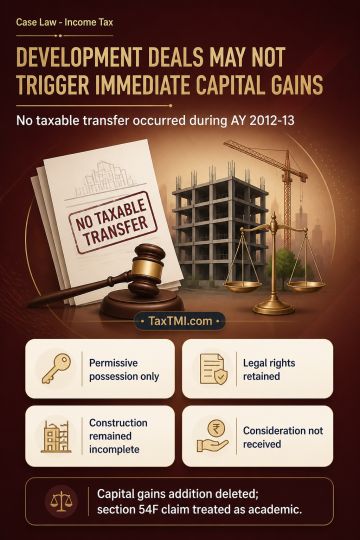
Development agreements require legal possession or effective enjoyment for capital gains transfer; permissive possession and deferred consideration de...
Prolonged sterilisation of development rights supports capital-gains treatment, while business-income disallowances cannot govern capital-gains comput...
Additional evidence in transfer pricing dispute leads to fresh examination, while tax deductions, TDS credit, fee and refund interest require verifica...
Category II AIF pass-through taxation preserves non-business income character; investment receipts cannot be reclassified without applying recognised ...
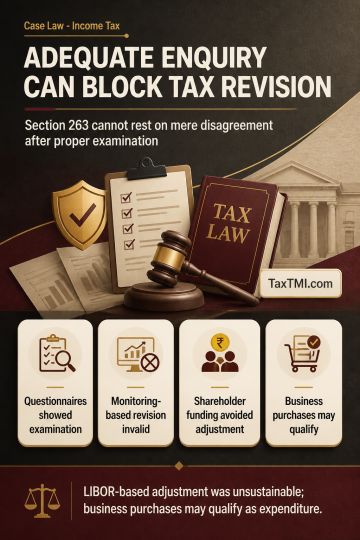
The Appellate Tribunal considered a case involving a revision u/s 263, where the Commissioner contended that the Assessing Officer did not adequately inquire into Long Term Capital Gain Exemptions u/s 54. The Tribunal found that the Assessing Officer had indeed examined the deduction u/s 54 and addressed the concerns raised, ultimately allowing the claim. The Commissioner did not identify any specific errors in the AO's actions, merely suggesting a need for further investigation without pinpointing any missed inquiries. The Tribunal concluded that the AO had taken a reasonable view during assessment, with no demonstrated errors by the revenue. As none of the conditions for revision u/s 263 were met, the order was not deemed erroneous or prejudicial to revenue, resulting in the appeal by the assessee being allowed.
The Appellate Tribunal considered a case involving a revision u/s 263, where the Commissioner contended that the Assessing Officer did not adequately inquire into Long Term Capital Gain Exemptions u/s 54. The Tribunal found that the Assessing Officer had indeed examined the deduction u/s 54 and addressed the concerns raised, ultimately allowing the claim. The Commissioner did not identify any specific errors in the AO's actions, merely suggesting a need for further investigation without pinpointing any missed inquiries. The Tribunal concluded that the AO had taken a reasonable view during assessment, with no demonstrated errors by the revenue. As none of the conditions for revision u/s 263 were met, the order was not deemed erroneous or prejudicial to revenue, resulting in the appeal by the assessee being allowed.
Note: It is a system-generated summary and is for quick reference only.
 TaxTMI
 of 4801













 Join Channel


 TaxTMI

