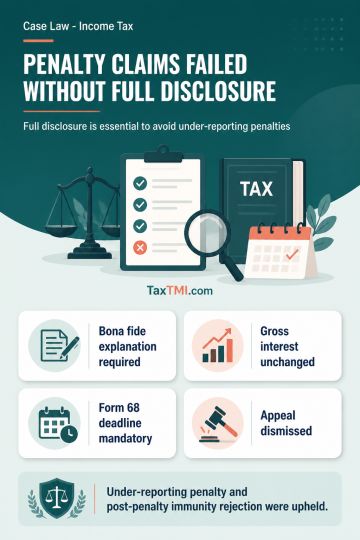
Bona fide disclosure requirements govern under-reporting penalties, and post-penalty immunity applications cannot secure available statutory protectio...
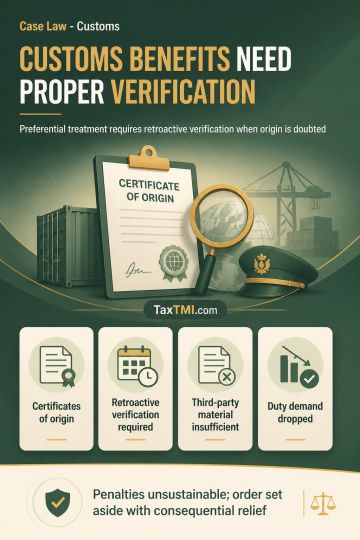
Certificate-of-origin verification procedure governs preferential customs benefits; denial without retroactive verification was set aside with consequ...
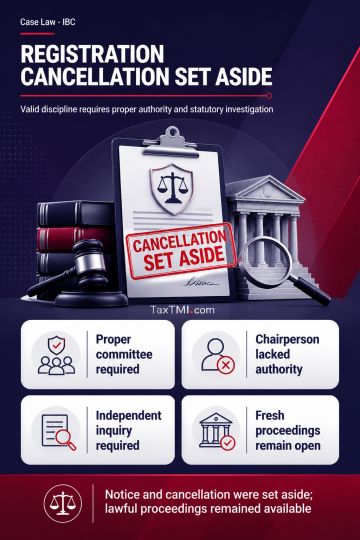
Disciplinary Committee jurisdiction and mandatory investigation requirements invalidated cancellation of an insolvency professional's registration and...
Retention of seized property survives where recorded reasons support proceeds of crime, while stayed investigation periods are excluded from limitatio...
Specified income of Baddi Barotiwala Nalagarh Development Authority receives conditional tax exemption, retrospectively covering its designated assess...
Page of 4794
Press 'Enter' after typing page number.
1001 to 1020 of 95872 Results
❮
❯
❯❯
0 / 200
Expand Note
Add to Folder
No Folders have been created
+
Are you sure you want to delete "My most important" ?
The High Court reviewed a case involving a violation of natural justice principles by a Commercial Taxes Officer. The initial order lacked verification of sales transactions and failed to provide a fair hearing to the assessee. Referring to a Supreme Court case, the Court emphasized the importance of cross-examination for credibility. The Assessing Authority did not verify the correctness of the petitioner's response, leading to an unsustainable conclusion. The Tax Board erred in not considering the legal infirmity of the Assessing Authority's decision. The Tax Board's interpretation of an abbreviation without supporting evidence was deemed unacceptable. The imposition of tax and penalty was based on flawed assumptions, leading to the Court setting aside the Tax Board's decision and affirming the Appellate Authority's order.
The High Court reviewed a case involving a violation of natural justice principles by a Commercial Taxes Officer. The initial order lacked verification of sales transactions and failed to provide a fair hearing to the assessee. Referring to a Supreme Court case, the Court emphasized the importance of cross-examination for credibility. The Assessing Authority did not verify the correctness of the petitioner's response, leading to an unsustainable conclusion. The Tax Board erred in not considering the legal infirmity of the Assessing Authority's decision. The Tax Board's interpretation of an abbreviation without supporting evidence was deemed unacceptable. The imposition of tax and penalty was based on flawed assumptions, leading to the Court setting aside the Tax Board's decision and affirming the Appellate Authority's order.
Note: It is a system-generated summary and is for quick reference only.
 TaxTMI
 of 4794











 Join Channel


 TaxTMI