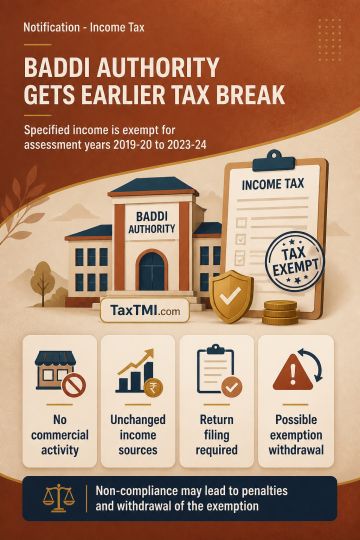
Specified income of Baddi Barotiwala Nalagarh Development Authority receives conditional tax exemption, retrospectively covering its designated assess...
Specified development authority income receives retrospective tax exemption, subject to non-commercial activity, unchanged income sources, and return-...
Unified Brand India framework introduces voluntary Trust Mark certification and funding support for export branding, packaging and global promotional ...
Origin Declaration authentication governs preferential tariff claims under India-UK CETA, requiring a validated reference number before import clearan...
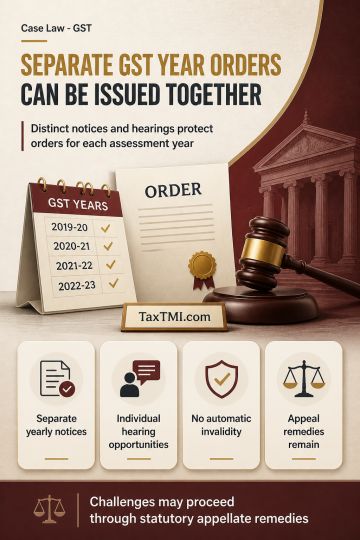
Separate assessment orders for different years remain valid when distinct notices and hearing opportunities prevent prejudice from combined proceeding...
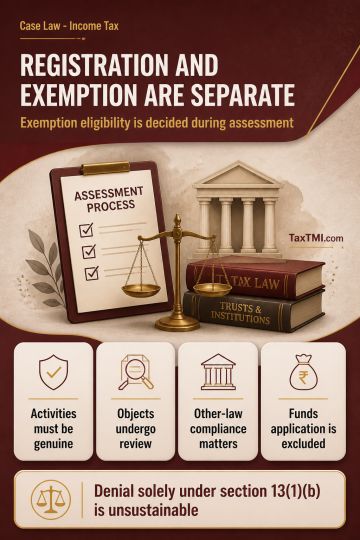
Defined public benefit can retain charitable character; registration renewal requires examining genuine activities and legal compliance, not surplus a...
Page of 4790
Press 'Enter' after typing page number.
941 to 960 of 95794 Results
❮
❯
❯❯
0 / 200
Expand Note
Add to Folder
No Folders have been created
+
Are you sure you want to delete "My most important" ?
The High Court considered whether orders abeying arbitration...
Arbitration proceedings paused due to moratorium not perverse. Debt held as whole. No splitting arbitration. No jurisdiction under Article 226. Dismissed.
Contents
Summary
Note
Bookmark
Share
✓ Copied successfully !
Print
Print Options
For full text, please login
Login to TaxTMI
Verification Pending
The Email Id has not been verified. Click on the link we have sent on
The High Court considered whether orders abeying arbitration proceedings during a moratorium period were so perverse as to warrant invoking writ jurisdiction due to a patent lack of inherent jurisdiction in the Arbitrator. The Court held that the debt under moratorium includes the liabilities of all borrowers and guarantors, without a distinction between them. The Court clarified that there is no provision for splitting arbitration proceedings, and they must be decided against all parties. The Tribunal's decision to stay proceedings during the moratorium was not illegal or perverse, thus the petition was dismissed. Sec. 138 and Sec. 139 of the IB Code were deemed irrelevant to the matter at hand.
The High Court considered whether orders abeying arbitration proceedings during a moratorium period were so perverse as to warrant invoking writ jurisdiction due to a patent lack of inherent jurisdiction in the Arbitrator. The Court held that the debt under moratorium includes the liabilities of all borrowers and guarantors, without a distinction between them. The Court clarified that there is no provision for splitting arbitration proceedings, and they must be decided against all parties. The Tribunal's decision to stay proceedings during the moratorium was not illegal or perverse, thus the petition was dismissed. Sec. 138 and Sec. 139 of the IB Code were deemed irrelevant to the matter at hand.
Note: It is a system-generated summary and is for quick reference only.
 TaxTMI
 of 4790











 Join Channel


 TaxTMI

