Authentication of paper assessment orders upheld, while qualifying repairs, consumables and vendor advance write-offs remain deductible business claim...
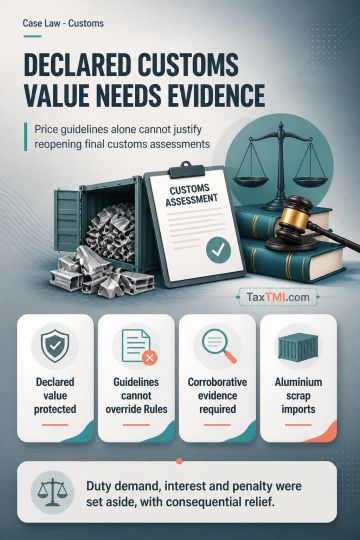
Transaction value cannot be rejected solely on non-statutory valuation guidelines without corroborative evidence supporting reassessment of final cust...
Cross-examination rights and corroborated evidence limit customs penalties for misdeclaration in genuine import transactions involving documented clea...
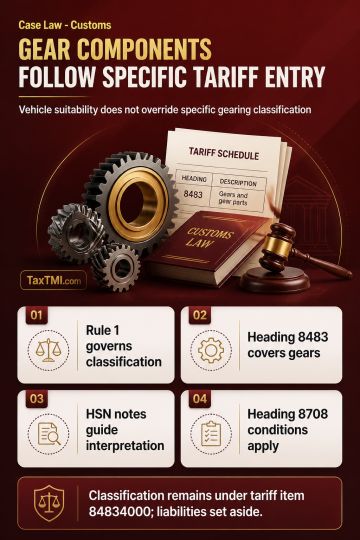
Tariff classification of vehicle gear components follows the specific gearing entry, displacing motor-vehicle parts classification and related liabili...
Necessary-party requirements limit impleadment of independent entities, while deferred consideration does not create an appealable adverse determinati...
The Appellate Tribunal found that the penalty was initiated u/s. 271DA instead of u/s. 271D, which led to confusion and violated the assessee's right to a fair hearing. The initiation of penalty under the wrong section was deemed arbitrary and against Article 14 of the Indian Constitution. The defective notice denied the assessee the opportunity to defend effectively. The Tribunal held that strict compliance with Sec. 274 of the Act is necessary for imposing penalties. Regarding the cash transactions exceeding Rs. 20,000, the Tribunal noted that the penalty was not justified as the assessee's explanations were not adequately addressed. The Tribunal also considered that the penalty notice was invalid, rendering the levied penalty unsustainable in law. The appeal by the assessee was allowed, and the penalty levied was ordered to be deleted.
The Appellate Tribunal found that the penalty was initiated u/s. 271DA instead of u/s. 271D, which led to confusion and violated the assessee's right to a fair hearing. The initiation of penalty under the wrong section was deemed arbitrary and against Article 14 of the Indian Constitution. The defective notice denied the assessee the opportunity to defend effectively. The Tribunal held that strict compliance with Sec. 274 of the Act is necessary for imposing penalties. Regarding the cash transactions exceeding Rs. 20,000, the Tribunal noted that the penalty was not justified as the assessee's explanations were not adequately addressed. The Tribunal also considered that the penalty notice was invalid, rendering the levied penalty unsustainable in law. The appeal by the assessee was allowed, and the penalty levied was ordered to be deleted.
Note: It is a system-generated summary and is for quick reference only.
 TaxTMI
 of 4803


















 Join Channel


 TaxTMI
