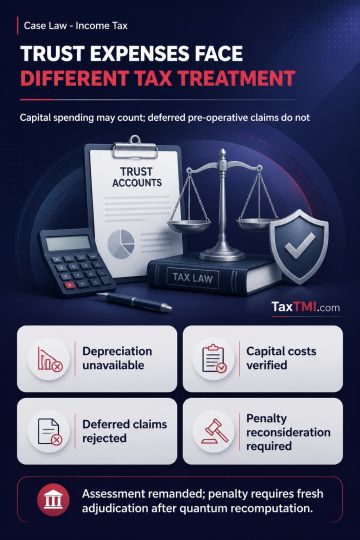
Charitable trust income application permits verified capital expenditure but rejects deferred pre-operative claims and requires reconsideration of con...
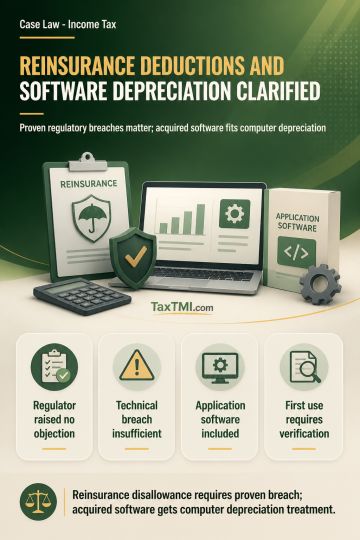
Reinsurance premium deductions require established regulatory breaches, while independently acquired software qualifies within the computer depreciati...
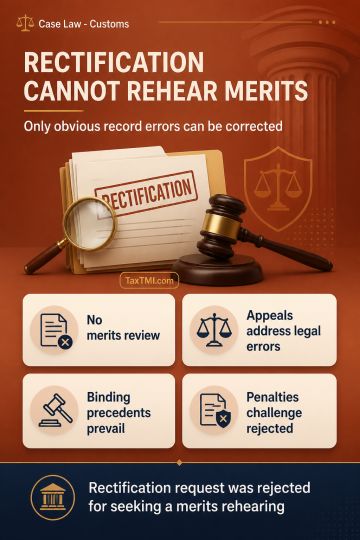
Rectification of mistake remains limited to self-evident record errors, preventing merits review through miscellaneous applications and preserving fin...
Tender creditworthiness conditions may extend to de facto Promoter Directors, with post-participation challenges generally barred absent arbitrariness...
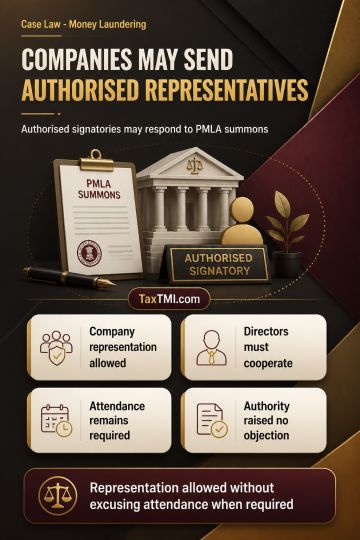
Corporate representation in PMLA summons proceedings permitted through an authorised signatory, subject to directors' continuing cooperation and atten...
The Appellate Tribunal addressed the issue of characterizing interconnect utility charges (IUC) as 'Royalty' for TDS u/s 195 of the Income Tax Act and India-Japan DTAA. The revenue argued that the payments constituted 'Royalty' due to the use of process or equipment. However, the Tribunal found that no intellectual property rights were transferred to service recipients, thus Explanation 2 to section 9(1)(vi) did not apply. The Tribunal also noted that changes in the Act did not impact the DTAA definition of 'Royalty.' Citing precedents, the Tribunal held that the payments for services provided did not qualify as 'Royalty' under section 9(1)(vi) Explanation 5 & 6. Since the process was not secret and no exclusive rights were granted, it couldn't be classified as 'Royalty' under the DTAA. The Tribunal ruled in favor of the assessee, stating that the payments constituted business profits taxable in the resident country and not in India, as there was no permanent establishment in India.
The Appellate Tribunal addressed the issue of characterizing interconnect utility charges (IUC) as 'Royalty' for TDS u/s 195 of the Income Tax Act and India-Japan DTAA. The revenue argued that the payments constituted 'Royalty' due to the use of process or equipment. However, the Tribunal found that no intellectual property rights were transferred to service recipients, thus Explanation 2 to section 9(1)(vi) did not apply. The Tribunal also noted that changes in the Act did not impact the DTAA definition of 'Royalty.' Citing precedents, the Tribunal held that the payments for services provided did not qualify as 'Royalty' under section 9(1)(vi) Explanation 5 & 6. Since the process was not secret and no exclusive rights were granted, it couldn't be classified as 'Royalty' under the DTAA. The Tribunal ruled in favor of the assessee, stating that the payments constituted business profits taxable in the resident country and not in India, as there was no permanent establishment in India.
Note: It is a system-generated summary and is for quick reference only.
 TaxTMI
 of 4805











 Join Channel


 TaxTMI
