Article 8 treaty coverage excluded third-party airline support services, while documented demonetisation cash receipts remained accepted business inco...
Functional comparability under TNMM requires highway contract benchmarks to reflect operation, maintenance and transfer activities, requiring fresh be...
Objective characteristics govern magnesium bis-glycinate chelate classification as an amino-acid coordination compound, not a food preparation or anti...
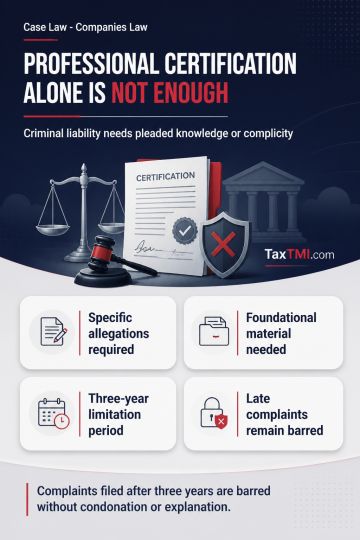
Independent professional certification requires pleaded knowledge or complicity for criminal liability; untimely complaints remain barred by limitatio...
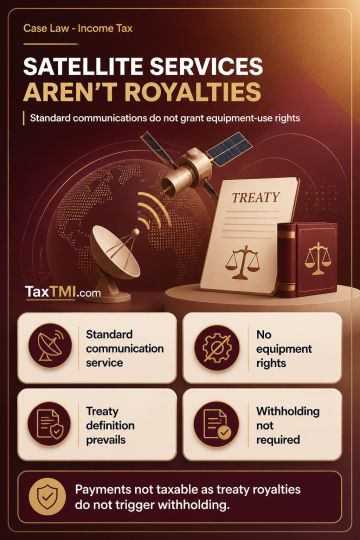
The Appellate Tribunal addressed the issue of characterizing interconnect utility charges (IUC) as 'Royalty' for TDS u/s 195 of the Income Tax Act and India-Japan DTAA. The revenue argued that the payments constituted 'Royalty' due to the use of process or equipment. However, the Tribunal found that no intellectual property rights were transferred to service recipients, thus Explanation 2 to section 9(1)(vi) did not apply. The Tribunal also noted that changes in the Act did not impact the DTAA definition of 'Royalty.' Citing precedents, the Tribunal held that the payments for services provided did not qualify as 'Royalty' under section 9(1)(vi) Explanation 5 & 6. Since the process was not secret and no exclusive rights were granted, it couldn't be classified as 'Royalty' under the DTAA. The Tribunal ruled in favor of the assessee, stating that the payments constituted business profits taxable in the resident country and not in India, as there was no permanent establishment in India.
The Appellate Tribunal addressed the issue of characterizing interconnect utility charges (IUC) as 'Royalty' for TDS u/s 195 of the Income Tax Act and India-Japan DTAA. The revenue argued that the payments constituted 'Royalty' due to the use of process or equipment. However, the Tribunal found that no intellectual property rights were transferred to service recipients, thus Explanation 2 to section 9(1)(vi) did not apply. The Tribunal also noted that changes in the Act did not impact the DTAA definition of 'Royalty.' Citing precedents, the Tribunal held that the payments for services provided did not qualify as 'Royalty' under section 9(1)(vi) Explanation 5 & 6. Since the process was not secret and no exclusive rights were granted, it couldn't be classified as 'Royalty' under the DTAA. The Tribunal ruled in favor of the assessee, stating that the payments constituted business profits taxable in the resident country and not in India, as there was no permanent establishment in India.
Note: It is a system-generated summary and is for quick reference only.
 TaxTMI
 of 4805













 Join Channel


 TaxTMI
