Inherited property sale proceeds require capital-gains treatment where ownership is supported by evidence, not suspicion or unverified signature doubt...
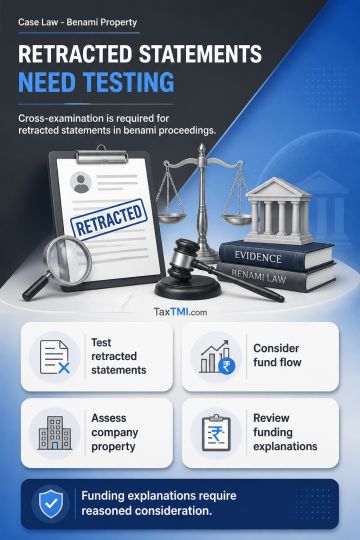
Cross-examination of retracted statements is essential where foundational evidence supports a benami allegation and documented funding explanations re...
Capital-goods exemption covers plant-modernisation accessories, while the import restriction applies only to earlier capital-goods components and spar...
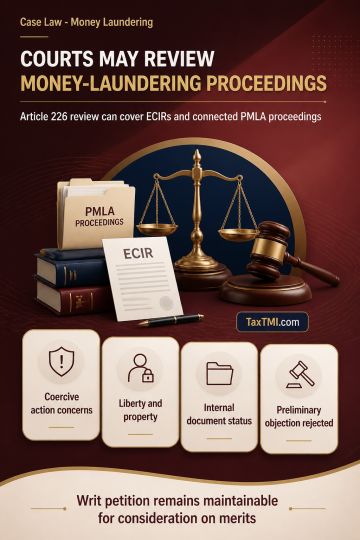
Constitutional judicial review permits challenges to ECIRs and connected money-laundering proceedings where coercive action affects fundamental intere...
The Appellate Tribunal addressed the issue of characterizing interconnect utility charges (IUC) as 'Royalty' for TDS u/s 195 of the Income Tax Act and India-Japan DTAA. The revenue argued that the payments constituted 'Royalty' due to the use of process or equipment. However, the Tribunal found that no intellectual property rights were transferred to service recipients, thus Explanation 2 to section 9(1)(vi) did not apply. The Tribunal also noted that changes in the Act did not impact the DTAA definition of 'Royalty.' Citing precedents, the Tribunal held that the payments for services provided did not qualify as 'Royalty' under section 9(1)(vi) Explanation 5 & 6. Since the process was not secret and no exclusive rights were granted, it couldn't be classified as 'Royalty' under the DTAA. The Tribunal ruled in favor of the assessee, stating that the payments constituted business profits taxable in the resident country and not in India, as there was no permanent establishment in India.
The Appellate Tribunal addressed the issue of characterizing interconnect utility charges (IUC) as 'Royalty' for TDS u/s 195 of the Income Tax Act and India-Japan DTAA. The revenue argued that the payments constituted 'Royalty' due to the use of process or equipment. However, the Tribunal found that no intellectual property rights were transferred to service recipients, thus Explanation 2 to section 9(1)(vi) did not apply. The Tribunal also noted that changes in the Act did not impact the DTAA definition of 'Royalty.' Citing precedents, the Tribunal held that the payments for services provided did not qualify as 'Royalty' under section 9(1)(vi) Explanation 5 & 6. Since the process was not secret and no exclusive rights were granted, it couldn't be classified as 'Royalty' under the DTAA. The Tribunal ruled in favor of the assessee, stating that the payments constituted business profits taxable in the resident country and not in India, as there was no permanent establishment in India.
Note: It is a system-generated summary and is for quick reference only.
 TaxTMI
 of 4805













 Join Channel


 TaxTMI