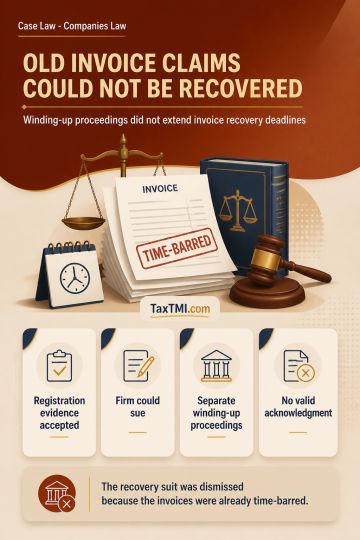
Invoice-based recovery claims remain time-barred despite separate winding-up proceedings, absent valid acknowledgment or part-payment of the disputed ...
Extended limitation fails without specific suppression allegations, while overseas employee secondment remains taxable as manpower supply within norma...
Time-share accommodation classification excludes Club or Association Service where purchasers receive contractual occupancy rights without genuine mem...
CENVAT credit for trading requires reversal, while taxable-service rental credit remains proportionately available and limitation issues await resolut...
Vicarious liability for dishonoured company cheques may extend to non-signatory directors where complaints contain foundational responsibility avermen...
The Appellate Tribunal addressed the issue of characterizing interconnect utility charges (IUC) as 'Royalty' for TDS u/s 195 of the Income Tax Act and India-Japan DTAA. The revenue argued that the payments constituted 'Royalty' due to the use of process or equipment. However, the Tribunal found that no intellectual property rights were transferred to service recipients, thus Explanation 2 to section 9(1)(vi) did not apply. The Tribunal also noted that changes in the Act did not impact the DTAA definition of 'Royalty.' Citing precedents, the Tribunal held that the payments for services provided did not qualify as 'Royalty' under section 9(1)(vi) Explanation 5 & 6. Since the process was not secret and no exclusive rights were granted, it couldn't be classified as 'Royalty' under the DTAA. The Tribunal ruled in favor of the assessee, stating that the payments constituted business profits taxable in the resident country and not in India, as there was no permanent establishment in India.
The Appellate Tribunal addressed the issue of characterizing interconnect utility charges (IUC) as 'Royalty' for TDS u/s 195 of the Income Tax Act and India-Japan DTAA. The revenue argued that the payments constituted 'Royalty' due to the use of process or equipment. However, the Tribunal found that no intellectual property rights were transferred to service recipients, thus Explanation 2 to section 9(1)(vi) did not apply. The Tribunal also noted that changes in the Act did not impact the DTAA definition of 'Royalty.' Citing precedents, the Tribunal held that the payments for services provided did not qualify as 'Royalty' under section 9(1)(vi) Explanation 5 & 6. Since the process was not secret and no exclusive rights were granted, it couldn't be classified as 'Royalty' under the DTAA. The Tribunal ruled in favor of the assessee, stating that the payments constituted business profits taxable in the resident country and not in India, as there was no permanent establishment in India.
Note: It is a system-generated summary and is for quick reference only.
 TaxTMI
 of 4803
















 Join Channel


 TaxTMI