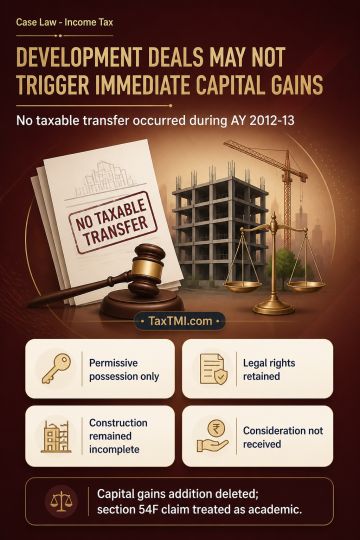
Development agreements require legal possession or effective enjoyment for capital gains transfer; permissive possession and deferred consideration de...
Prolonged sterilisation of development rights supports capital-gains treatment, while business-income disallowances cannot govern capital-gains comput...
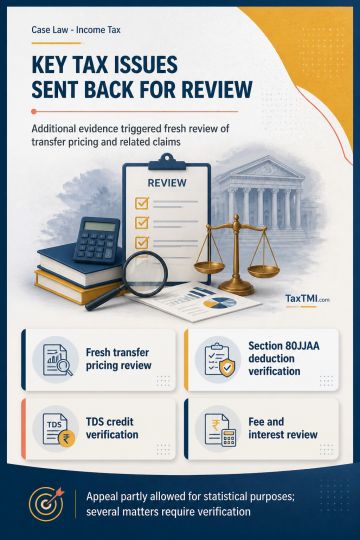
Additional evidence in transfer pricing dispute leads to fresh examination, while tax deductions, TDS credit, fee and refund interest require verifica...
Category II AIF pass-through taxation preserves non-business income character; investment receipts cannot be reclassified without applying recognised ...
Mutual fund maturity rules require proper rollover, redemption, disclosure, and due diligence; investor gains cannot excuse regulatory breaches or pen...
CESTAT, an Appellate Tribunal, considered a case involving penalty u/s 114AA of the Customs Act, 1962 on a co-noticee who is a Partner in a Customs Broker firm for undervaluation of imported power tools from China. The Tribunal noted that Section 114AA allows a penalty not exceeding five times the value of goods under specific circumstances. It was observed that other sections like 112 and 114A also deal with penalties, and subsequent sections like 114AB and 114AC were introduced later. Referring to a relevant case, it was highlighted that penalties under 114AA require mens rea or conscious knowledge, which was not present in the appellant's case. The Tribunal found that the appellant's involvement as a customs broker did not involve criminal intent or duty evasion, and thus, the penalty u/s 114AA was deemed inapplicable. Consequently, the penalty imposed on the appellant was set aside, and the appeal was allowed.
CESTAT, an Appellate Tribunal, considered a case involving penalty u/s 114AA of the Customs Act, 1962 on a co-noticee who is a Partner in a Customs Broker firm for undervaluation of imported power tools from China. The Tribunal noted that Section 114AA allows a penalty not exceeding five times the value of goods under specific circumstances. It was observed that other sections like 112 and 114A also deal with penalties, and subsequent sections like 114AB and 114AC were introduced later. Referring to a relevant case, it was highlighted that penalties under 114AA require mens rea or conscious knowledge, which was not present in the appellant's case. The Tribunal found that the appellant's involvement as a customs broker did not involve criminal intent or duty evasion, and thus, the penalty u/s 114AA was deemed inapplicable. Consequently, the penalty imposed on the appellant was set aside, and the appeal was allowed.
Note: It is a system-generated summary and is for quick reference only.
 TaxTMI
 of 4807











 Join Channel


 TaxTMI