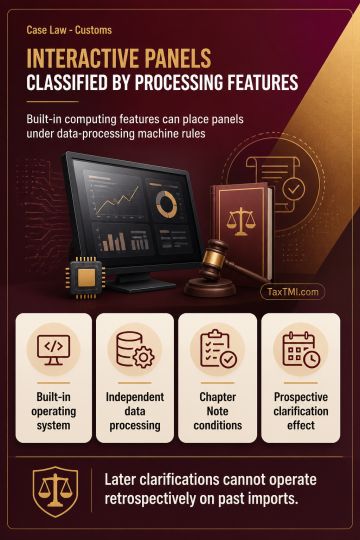
Interactive flat panels meeting automatic data processing conditions are distinguished from monitors, while later classification clarifications apply ...
Statutory transfer formalities invalidated alleged share and property transfers, while retrospective record manipulation constituted oppression and mi...
Provisional attachment of laundered funds and equivalent-value property sustained, with statutory protection limited to pension, gratuity and providen...
In a case involving dishonour of a cheque due to variance in signature, the petitioner failed to cross-examine the respondent, leading to invocation of Section 391 of Cr.P.C. The High Court held that evidence must include cross-examination to be complete, especially in cases under Section 138 NI Act where statutory presumption against the accused must be dislodged. Referring to Rambhau vs. State of Maharashtra, the Court emphasized that Section 391 Cr.P.C. allows for additional evidence to secure justice. As the respondent was not cross-examined and crucial transaction details required clarification, the Court allowed the criminal revision petition, highlighting the necessity of examining the respondent's mother as an additional witness.
In a case involving dishonour of a cheque due to variance in signature, the petitioner failed to cross-examine the respondent, leading to invocation of Section 391 of Cr.P.C. The High Court held that evidence must include cross-examination to be complete, especially in cases under Section 138 NI Act where statutory presumption against the accused must be dislodged. Referring to Rambhau vs. State of Maharashtra, the Court emphasized that Section 391 Cr.P.C. allows for additional evidence to secure justice. As the respondent was not cross-examined and crucial transaction details required clarification, the Court allowed the criminal revision petition, highlighting the necessity of examining the respondent's mother as an additional witness.
Note: It is a system-generated summary and is for quick reference only.
 TaxTMI
 of 4800









 Join Channel


 TaxTMI
