Defined public benefit can retain charitable character; registration renewal requires examining genuine activities and legal compliance, not surplus a...
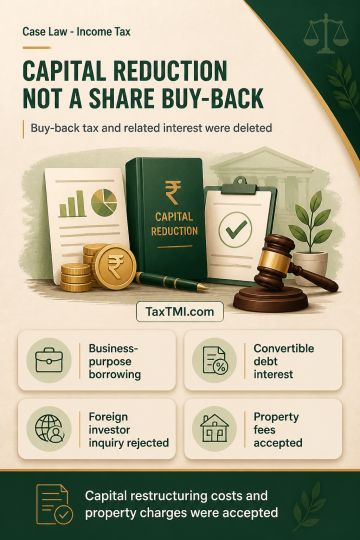
Capital reduction is distinct from share buy-back, preventing buy-back tax; restructuring interest and related business deductions also survive scruti...
Transfer pricing and tax deductions upheld on established principles, while employee contributions and warranty provisions returned for fresh examinat...
Captive transfer pricing relies on industrial consumer tariffs, while genuine quotations can benchmark effluent treatment transfers under the Other Me...
Specific tariff classification for ophthalmic instruments and extended limitation principles determine the treatment of duty demands, confiscation, an...
The Appellate Tribunal addressed two key issues. Firstly, it ruled that disallowance of unpaid interest u/s 43B on a loan from the World Bank, advanced by the State Government, was not valid. The Tribunal clarified that interest payable to the State Government or World Bank is not covered u/s 43B, as these entities do not fall under the definition of covered financial institutions. Therefore, the disallowance was directed to be deleted. Secondly, regarding the addition on account of electricity duty u/s 43B, the Tribunal held that the duty collected by the assessee from consumers does not constitute trading receipts. As the duty is collected on behalf of the government and not levied on the assessee, section 43B does not apply. The Tribunal cited a Kerala High Court case, upheld by the Supreme Court, to support this ruling. Thus, the Tribunal decided in favor of the assessee on this issue as well.
The Appellate Tribunal addressed two key issues. Firstly, it ruled that disallowance of unpaid interest u/s 43B on a loan from the World Bank, advanced by the State Government, was not valid. The Tribunal clarified that interest payable to the State Government or World Bank is not covered u/s 43B, as these entities do not fall under the definition of covered financial institutions. Therefore, the disallowance was directed to be deleted. Secondly, regarding the addition on account of electricity duty u/s 43B, the Tribunal held that the duty collected by the assessee from consumers does not constitute trading receipts. As the duty is collected on behalf of the government and not levied on the assessee, section 43B does not apply. The Tribunal cited a Kerala High Court case, upheld by the Supreme Court, to support this ruling. Thus, the Tribunal decided in favor of the assessee on this issue as well.
Note: It is a system-generated summary and is for quick reference only.
 TaxTMI
 of 4805

















 Join Channel


 TaxTMI

