Development agreements require legal possession or effective enjoyment for capital gains transfer; permissive possession and deferred consideration de...
Prolonged sterilisation of development rights supports capital-gains treatment, while business-income disallowances cannot govern capital-gains comput...
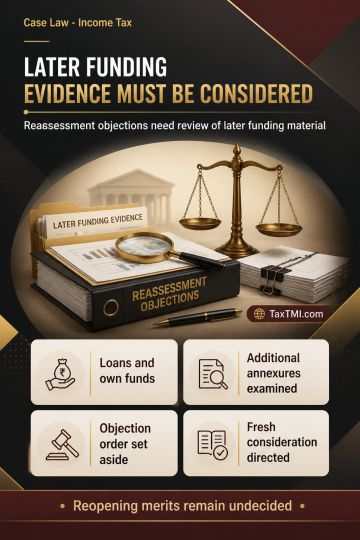
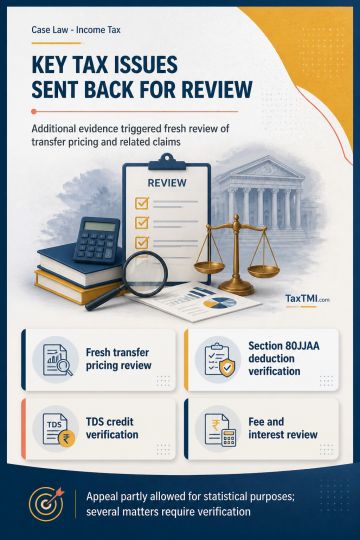
Additional evidence in transfer pricing dispute leads to fresh examination, while tax deductions, TDS credit, fee and refund interest require verifica...
Category II AIF pass-through taxation preserves non-business income character; investment receipts cannot be reclassified without applying recognised ...
The High Court dismissed the petitioner's challenge to the reopening of assessment u/s 147, citing the petitioner's delayed compliance with notice u/s 148 and failure to challenge the re-assessment notice or reasons for reassessment. The Court held that the petitioner's failure to avail the statutory appeal remedy precluded invoking writ jurisdiction. The Court noted factual issues requiring adjudication beyond Article 226 scope, such as delay in statutory audit and compliance with Co-operative Societies Act. The petitioner's contention on the doctrine of merger was deemed misconceived. The Court refrained from opining on audit merits, urging the petitioner to pursue appellate remedy. The Court dismissed the writ applications, advising the petitioner to challenge the orders before the appellate authority, with the possibility of condoning the limitation period for filing appeals.
The High Court dismissed the petitioner's challenge to the reopening of assessment u/s 147, citing the petitioner's delayed compliance with notice u/s 148 and failure to challenge the re-assessment notice or reasons for reassessment. The Court held that the petitioner's failure to avail the statutory appeal remedy precluded invoking writ jurisdiction. The Court noted factual issues requiring adjudication beyond Article 226 scope, such as delay in statutory audit and compliance with Co-operative Societies Act. The petitioner's contention on the doctrine of merger was deemed misconceived. The Court refrained from opining on audit merits, urging the petitioner to pursue appellate remedy. The Court dismissed the writ applications, advising the petitioner to challenge the orders before the appellate authority, with the possibility of condoning the limitation period for filing appeals.
Note: It is a system-generated summary and is for quick reference only.
 TaxTMI
  TaxTMI
 of 4807
















 Join Channel


