Transfer pricing comparability requires functional alignment, reliable financial data, and careful review of working capital and receivables adjustmen...
Transfer pricing rules require benchmarking corporate guarantees and associated-enterprise advances, while invalid domestic-transaction adjustments ca...
Prospective sugar export prohibition required registered letters of credit; private contracts and export quotas created no enforceable continuation ri...
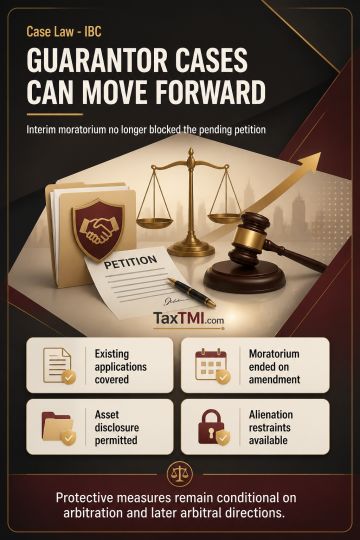
Retroactive interim-moratorium exclusion permits protective asset disclosure and preservation measures against personal guarantors pending arbitration...
The High Court dismissed the petitioner's challenge to the reopening of assessment u/s 147, citing the petitioner's delayed compliance with notice u/s 148 and failure to challenge the re-assessment notice or reasons for reassessment. The Court held that the petitioner's failure to avail the statutory appeal remedy precluded invoking writ jurisdiction. The Court noted factual issues requiring adjudication beyond Article 226 scope, such as delay in statutory audit and compliance with Co-operative Societies Act. The petitioner's contention on the doctrine of merger was deemed misconceived. The Court refrained from opining on audit merits, urging the petitioner to pursue appellate remedy. The Court dismissed the writ applications, advising the petitioner to challenge the orders before the appellate authority, with the possibility of condoning the limitation period for filing appeals.
The High Court dismissed the petitioner's challenge to the reopening of assessment u/s 147, citing the petitioner's delayed compliance with notice u/s 148 and failure to challenge the re-assessment notice or reasons for reassessment. The Court held that the petitioner's failure to avail the statutory appeal remedy precluded invoking writ jurisdiction. The Court noted factual issues requiring adjudication beyond Article 226 scope, such as delay in statutory audit and compliance with Co-operative Societies Act. The petitioner's contention on the doctrine of merger was deemed misconceived. The Court refrained from opining on audit merits, urging the petitioner to pursue appellate remedy. The Court dismissed the writ applications, advising the petitioner to challenge the orders before the appellate authority, with the possibility of condoning the limitation period for filing appeals.
Note: It is a system-generated summary and is for quick reference only.
 TaxTMI
 of 4805













 Join Channel


 TaxTMI