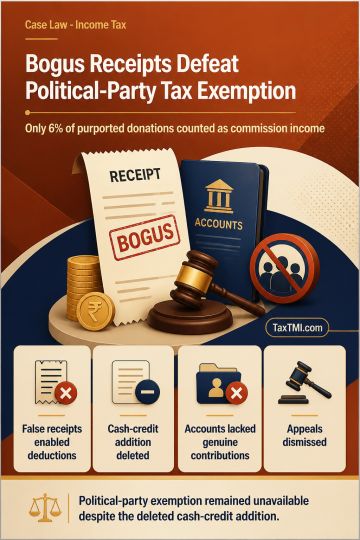
Bogus donation receipts justified commission income assessment and defeated political-party tax exemption for inaccurate accounts and reporting failur...
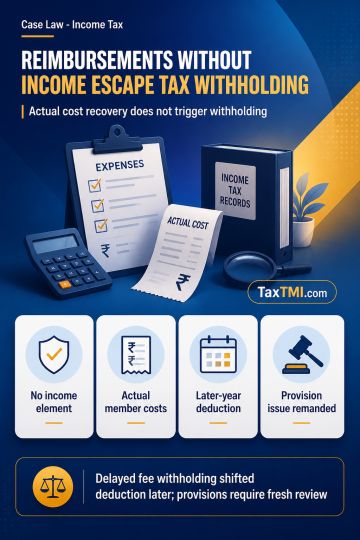
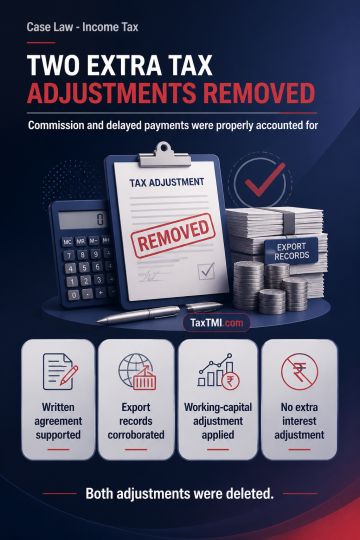
Pure reimbursement without income element escapes tax withholding, while delayed withholding and unsupported provisions face deferred or renewed scrut...
Public benefit requirement defeats charitable registration where residents' association services are reciprocal, member-only facilities governed by mu...
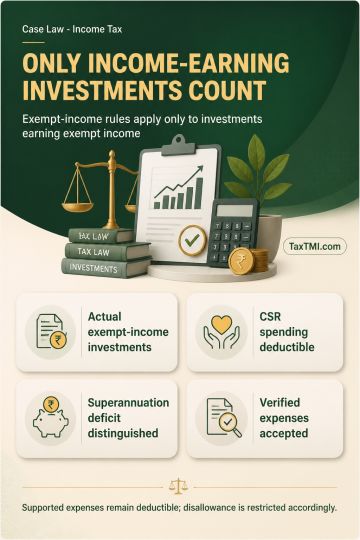
Exempt-income expenditure disallowance is confined to investments that actually generated exempt income, while supported business expenses remain dedu...
Objective characteristics and principal use govern mining-tyre classification, while fresh advance ruling applications may rely on additional technica...
Page of 4805
Press 'Enter' after typing page number.
801 to 820 of 96092 Results
❮
❯
❯❯
0 / 200
Expand Note
Add to Folder
No Folders have been created
+
Are you sure you want to delete "My most important" ?
The Appellate Tribunal found the Appellant in contravention of the Foreign Exchange Regulation Act (FERA) for instructing Indian Banks to credit accounts of non-residents, leading to prohibited transactions. The Tribunal directed the Appellant to provide an unconditional bank guarantee for the penalty amount u/s 52(2) of FERA. The Appellant's denial of responsibility despite initiating the transactions showed intentional engagement in prohibited activities. FERA aimed to regulate foreign exchange transactions for economic development. The burden of proof regarding culpable mental state was on the Appellant, which it failed to discharge, establishing abetment under FERA sections. The Tribunal deemed the penalty amount disproportionate to the offense and adjusted it for justice.
The Appellate Tribunal found the Appellant in contravention of the Foreign Exchange Regulation Act (FERA) for instructing Indian Banks to credit accounts of non-residents, leading to prohibited transactions. The Tribunal directed the Appellant to provide an unconditional bank guarantee for the penalty amount u/s 52(2) of FERA. The Appellant's denial of responsibility despite initiating the transactions showed intentional engagement in prohibited activities. FERA aimed to regulate foreign exchange transactions for economic development. The burden of proof regarding culpable mental state was on the Appellant, which it failed to discharge, establishing abetment under FERA sections. The Tribunal deemed the penalty amount disproportionate to the offense and adjusted it for justice.
Note: It is a system-generated summary and is for quick reference only.
 TaxTMI
 of 4805












 Join Channel


 TaxTMI