Tax exemption for specified legal-services authority income applies retrospectively, subject to non-commercial activity, unchanged income sources, and...
Approved resolution plans extinguish unsubmitted pre-approval tax claims, preventing later recovery outside the insolvency process and preserving a cl...
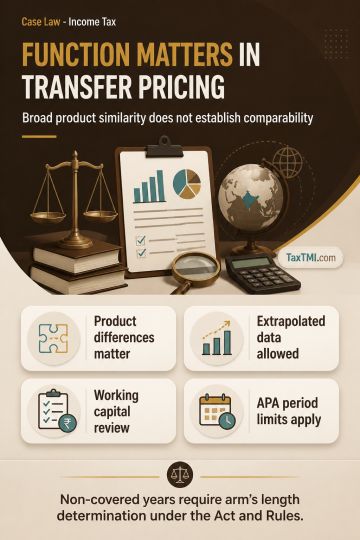
Transfer pricing comparability requires functional alignment and permits working capital adjustment, while APA margins cannot govern non-covered years...
Treaty benefit, goodwill depreciation and hedging costs: export commission disallowed, while key business deductions and depreciation claims succeeded...
Page of 4790
Press 'Enter' after typing page number.
681 to 700 of 95794 Results
❮
❯
❯❯
0 / 200
Expand Note
Add to Folder
No Folders have been created
+
Are you sure you want to delete "My most important" ?
The Appellate Tribunal addressed the issue of rejection of approval u/s 80G due to late filing of Form 10AB. The Tribunal held that the CIT(E) should have considered the application on merits rather than declaring it non-maintainable solely based on the commencement date of activities. The assessee obtained provisional approval and filed Form 10AB within the specified time frame, meeting the requirements of Section 80G(5)(iii). The Tribunal emphasized that the commencement date of activities before incorporation was irrelevant in this case. The phrase "whichever is earlier" was deemed inapplicable given the unique circumstances of the case. The decision lacked a thorough examination of the merits of the application, highlighting a legal flaw in the approach taken.
The Appellate Tribunal addressed the issue of rejection of approval u/s 80G due to late filing of Form 10AB. The Tribunal held that the CIT(E) should have considered the application on merits rather than declaring it non-maintainable solely based on the commencement date of activities. The assessee obtained provisional approval and filed Form 10AB within the specified time frame, meeting the requirements of Section 80G(5)(iii). The Tribunal emphasized that the commencement date of activities before incorporation was irrelevant in this case. The phrase "whichever is earlier" was deemed inapplicable given the unique circumstances of the case. The decision lacked a thorough examination of the merits of the application, highlighting a legal flaw in the approach taken.
Note: It is a system-generated summary and is for quick reference only.
 TaxTMI
 of 4790

















 Join Channel


 TaxTMI