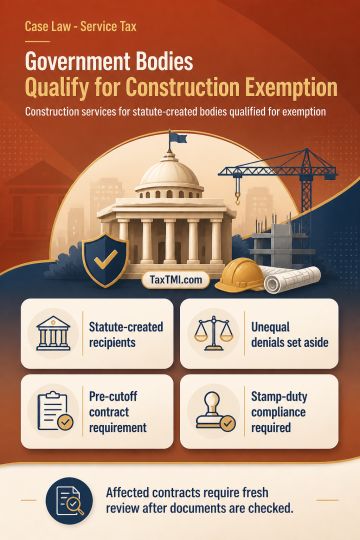
Governmental authority status supports construction-service exemption, while pre-cutoff contract and stamp-duty compliance requires verification on re...
Automated Free Sale and Commerce Certificates enable paperless processing while retaining risk-based manual verification for selected exporter applica...
Employee stock-shortage penalties do not constitute consideration for services, preventing GST collection under Schedule II in employment relationship...
The High Court addressed the challenge to the acquittal of the accused u/s 255(1) of Cr. P. C. for dishonoring a cheque due to insufficient funds. It clarified that the statutory notice period starts from the date of receiving information from the bank about the dishonored cheque, not the exact dishonor date. The court upheld the validity of the notice despite the inclusion of a demand for legal interest alongside the cheque amount. Citing Suman Sethi v. Ajay K. Churiwal, it emphasized that separate claims in the notice are permissible and do not invalidate it. Consequently, the accused was convicted u/s 138 of the NI Act, sentenced to imprisonment till the rising of the court, and ordered to pay Rs.70,000 compensation u/s 357(3) Cr.P.C, with a default clause for further imprisonment if the compensation is not paid. The appeal was allowed, overturning the previous judgment.
The High Court addressed the challenge to the acquittal of the accused u/s 255(1) of Cr. P. C. for dishonoring a cheque due to insufficient funds. It clarified that the statutory notice period starts from the date of receiving information from the bank about the dishonored cheque, not the exact dishonor date. The court upheld the validity of the notice despite the inclusion of a demand for legal interest alongside the cheque amount. Citing Suman Sethi v. Ajay K. Churiwal, it emphasized that separate claims in the notice are permissible and do not invalidate it. Consequently, the accused was convicted u/s 138 of the NI Act, sentenced to imprisonment till the rising of the court, and ordered to pay Rs.70,000 compensation u/s 357(3) Cr.P.C, with a default clause for further imprisonment if the compensation is not paid. The appeal was allowed, overturning the previous judgment.
Note: It is a system-generated summary and is for quick reference only.
 TaxTMI
  TaxTMI
 of 4828







 Join Channel


