Governmental authority status supports construction-service exemption, while pre-cutoff contract and stamp-duty compliance requires verification on re...
Automated Free Sale and Commerce Certificates enable paperless processing while retaining risk-based manual verification for selected exporter applica...
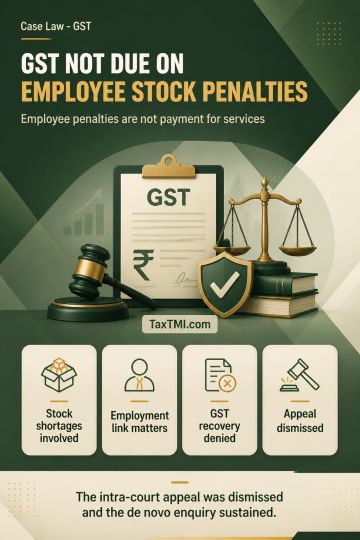
Employee stock-shortage penalties do not constitute consideration for services, preventing GST collection under Schedule II in employment relationship...
The ITAT reviewed a case involving the revision u/s 263 regarding the accrual of interest income on contributions made by the assessee towards Core Settlement Guarantee Fund. The CIT held that the AO erred in not examining the taxability of the accrued interest income before allowing its application in the accounts. The ITAT found that the contributions to the fund were under the control of ICCL and created to safeguard investors' interests, with any income accrued being exempt u/s 10(23EE) of the Act. The ITAT determined that the AO had collected and verified relevant information, and the PCIT did not demonstrate how the income earned by ICCL was chargeable to tax in the assessee's hands. The ITAT concluded that while the AO's order may be considered erroneous, it did not meet the condition of being prejudicial to revenue, ruling in favor of the assessee.
The ITAT reviewed a case involving the revision u/s 263 regarding the accrual of interest income on contributions made by the assessee towards Core Settlement Guarantee Fund. The CIT held that the AO erred in not examining the taxability of the accrued interest income before allowing its application in the accounts. The ITAT found that the contributions to the fund were under the control of ICCL and created to safeguard investors' interests, with any income accrued being exempt u/s 10(23EE) of the Act. The ITAT determined that the AO had collected and verified relevant information, and the PCIT did not demonstrate how the income earned by ICCL was chargeable to tax in the assessee's hands. The ITAT concluded that while the AO's order may be considered erroneous, it did not meet the condition of being prejudicial to revenue, ruling in favor of the assessee.
Note: It is a system-generated summary and is for quick reference only.
 TaxTMI
  TaxTMI
 of 4828












 Join Channel


