TNMM functional comparability requires excluding rice manufacturers from a pure Basmati rice trader's benchmark and recognising operating export recei...
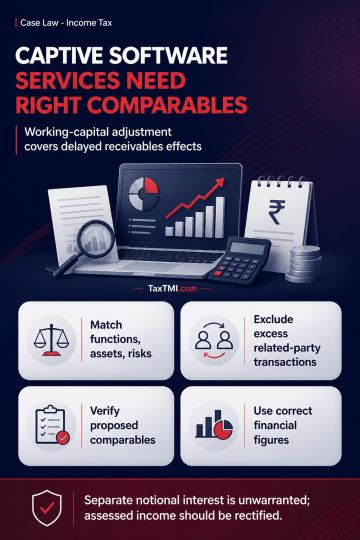
Working-capital adjustment subsumes delayed-receivable effects in TNMM benchmarking of captive software-development services, avoiding separate notion...
Transfer-pricing comparability requires exclusion of financially illogical super-profit comparables and correction of unsupported annual-report and ma...
Charitable character assessment preserves Section 80G approval despite inclusive spiritual teachings and incidental religious expenditure within the s...
Penalty proceedings for cash-loan acceptance require assessment proceedings and recorded Assessing Officer satisfaction; absent these, the proceedings...
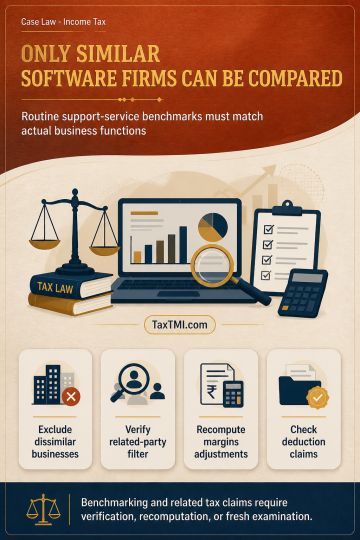
Functional comparability governs software-service benchmarking: dissimilar companies are excluded, while related-party filters, margins and working-ca...
The Appellate Tribunal addressed various issues in the case. Firstly, regarding disallowance u/s. 14A r.w.r. 8D, the Tribunal upheld the consistency principle in the methodology of computation accepted in prior years. Secondly, it ruled in favor of the assessee on the nature of expenses, considering expenditure on shelved projects as revenue. Thirdly, it allowed prior period expenditure disallowance based on mercantile accounting. Fourthly, it reversed the disallowance of discount on Euro Notes issuance. Fifthly, it directed the AO to decide on premium deduction impact u/s. 80IA based on previous rulings. Sixthly, it upheld the deduction claim u/s. 80IA for a wind power project. Seventhly, it remanded the issue of duplicate disallowance for re-examination. Lastly, it addressed Transfer Pricing adjustments, including guarantee fees and loan interest, directing the TPO to reconsider certain aspects for TP adjustments.
The Appellate Tribunal addressed various issues in the case. Firstly, regarding disallowance u/s. 14A r.w.r. 8D, the Tribunal upheld the consistency principle in the methodology of computation accepted in prior years. Secondly, it ruled in favor of the assessee on the nature of expenses, considering expenditure on shelved projects as revenue. Thirdly, it allowed prior period expenditure disallowance based on mercantile accounting. Fourthly, it reversed the disallowance of discount on Euro Notes issuance. Fifthly, it directed the AO to decide on premium deduction impact u/s. 80IA based on previous rulings. Sixthly, it upheld the deduction claim u/s. 80IA for a wind power project. Seventhly, it remanded the issue of duplicate disallowance for re-examination. Lastly, it addressed Transfer Pricing adjustments, including guarantee fees and loan interest, directing the TPO to reconsider certain aspects for TP adjustments.
Note: It is a system-generated summary and is for quick reference only.
 TaxTMI
  TaxTMI
 of 4830

















 Join Channel


