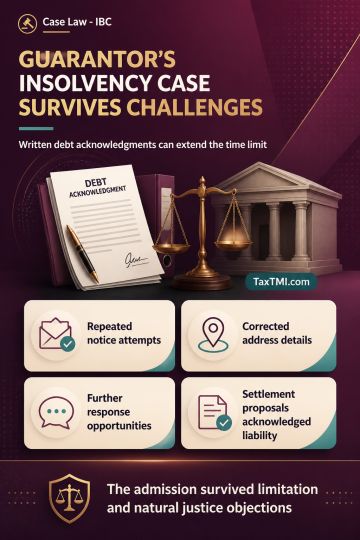
Service of notice and contractual debt acknowledgment preserved insolvency admission against a corporate guarantor despite limitation and natural just...
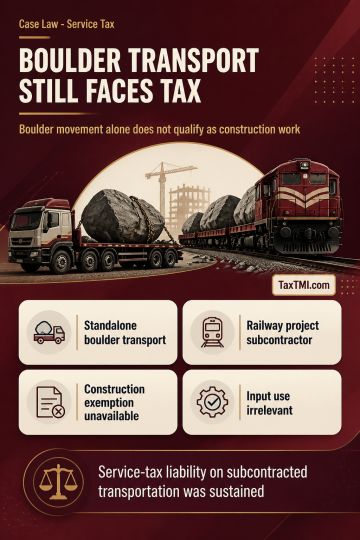
Original works exemption excludes standalone boulder transportation, leaving subcontracted railway-project transport services subject to service tax l...
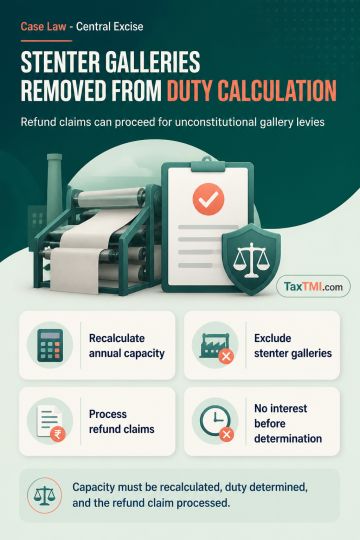
Annual production capacity determinations excluding stenter galleries support refunds for unconstitutional excise levies without an unjust-enrichment ...
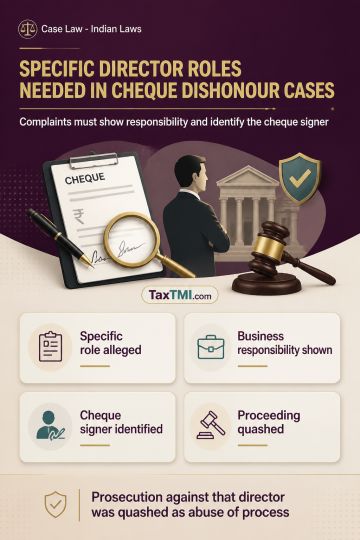
Vicarious liability for cheque dishonour requires specific allegations of responsibility and cheque signatory; generic director allegations cannot sus...
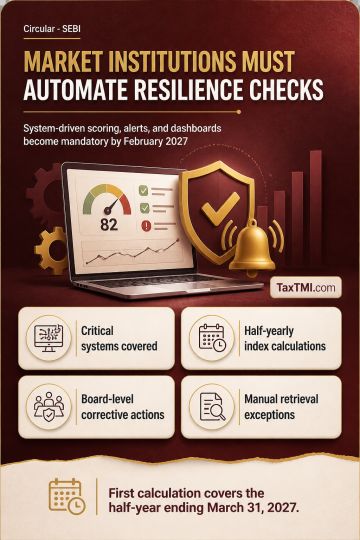
IT Resilience Index requires market infrastructure institutions to automate resilience scoring, early warnings, and continuous service-delivery monito...
The High Court addressed a case involving the dishonour of a cheque and the imposition of a condition to deposit a specific amount u/s 148 of the Negotiable Instruments Act. Referring to a Supreme Court decision, it was emphasized that the appellate court must provide reasons for imposing such conditions and cannot issue a blanket order for all cases. The court highlighted the need for a speaking order when ordering a deposit, which can vary from the minimum prescribed amount. The High Court found the lower court's order unsustainable as it lacked proper reasoning and did not require the appellant to execute a bond. Consequently, the direction to deposit 20% of the compensation amount was set aside, and the criminal case was allowed.
The High Court addressed a case involving the dishonour of a cheque and the imposition of a condition to deposit a specific amount u/s 148 of the Negotiable Instruments Act. Referring to a Supreme Court decision, it was emphasized that the appellate court must provide reasons for imposing such conditions and cannot issue a blanket order for all cases. The court highlighted the need for a speaking order when ordering a deposit, which can vary from the minimum prescribed amount. The High Court found the lower court's order unsustainable as it lacked proper reasoning and did not require the appellant to execute a bond. Consequently, the direction to deposit 20% of the compensation amount was set aside, and the criminal case was allowed.
Note: It is a system-generated summary and is for quick reference only.
 TaxTMI
  TaxTMI
 of 4828






 Join Channel