Specified income of Baddi Barotiwala Nalagarh Development Authority receives conditional tax exemption, retrospectively covering its designated assess...
Specified development authority income receives retrospective tax exemption, subject to non-commercial activity, unchanged income sources, and return-...
Unified Brand India framework introduces voluntary Trust Mark certification and funding support for export branding, packaging and global promotional ...
Origin Declaration authentication governs preferential tariff claims under India-UK CETA, requiring a validated reference number before import clearan...
Separate assessment orders for different years remain valid when distinct notices and hearing opportunities prevent prejudice from combined proceeding...
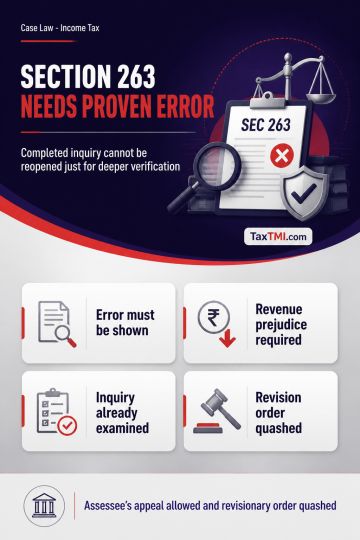
The ITAT Jaipur addressed a case involving a revision u/s 263 concerning the addition u/s 68 based on a report from an investigation in Mumbai. The PCIT contended that the AO did not properly examine the issue of bogus LTCG, leading to the need for the LTCG claimed to be added to the assessee's total income. The tribunal emphasized that for u/s 263 to apply, the assessment order must be both erroneous and prejudicial to revenue. Mere loss of revenue due to the AO's decision does not automatically make the order prejudicial. The tribunal found no incorrectness in the AO's actions and concluded that the PCIT's order did not meet the requirements of u/s 263. The tribunal held that a change of opinion by the PCIT is not permissible under the law, ultimately allowing the assessee's appeal.
The ITAT Jaipur addressed a case involving a revision u/s 263 concerning the addition u/s 68 based on a report from an investigation in Mumbai. The PCIT contended that the AO did not properly examine the issue of bogus LTCG, leading to the need for the LTCG claimed to be added to the assessee's total income. The tribunal emphasized that for u/s 263 to apply, the assessment order must be both erroneous and prejudicial to revenue. Mere loss of revenue due to the AO's decision does not automatically make the order prejudicial. The tribunal found no incorrectness in the AO's actions and concluded that the PCIT's order did not meet the requirements of u/s 263. The tribunal held that a change of opinion by the PCIT is not permissible under the law, ultimately allowing the assessee's appeal.
Note: It is a system-generated summary and is for quick reference only.
 TaxTMI
 of 4798
















 Join Channel


 TaxTMI

